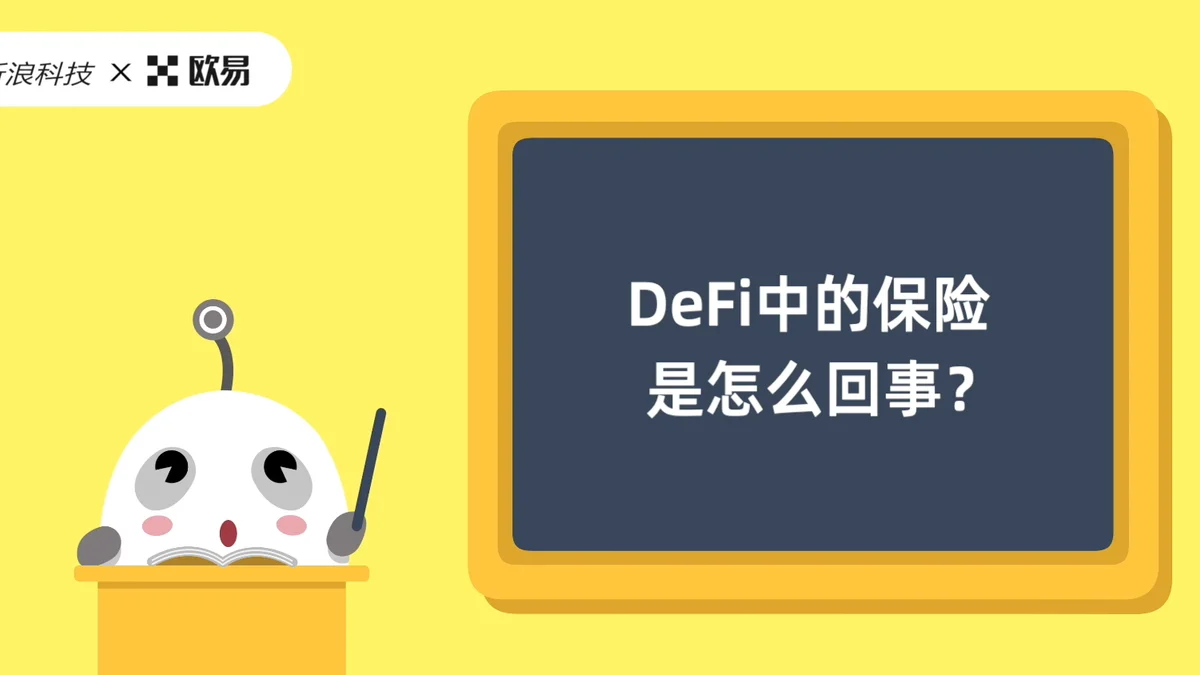
OKX Blockchain 60 Episodes | DeFi Episode 5: How Does Insurance Work in DeFi?
Hello everyone, I'm Xiao K, and today we're going to talk about: "How Does Insurance Work in DeFi"?
As we all know, in the traditional financial world, besides lending, funds, and exchanges, there is another area closely related to all of us—insurance. DeFi, as the decentralized counterpart of the financial sector, naturally includes insurance services. So today, Xiao K will explain how the insurance sector works in DeFi.
In traditional finance, we purchase insurance to guard against certain risks, such as auto insurance, personal safety insurance, and so on. DeFi insurance, like traditional insurance, also serves the purpose of risk prevention, but it targets digital asset risks commonly seen in the decentralized world, such as stolen private keys, hacker attacks, and manipulation due to smart contract vulnerabilities.
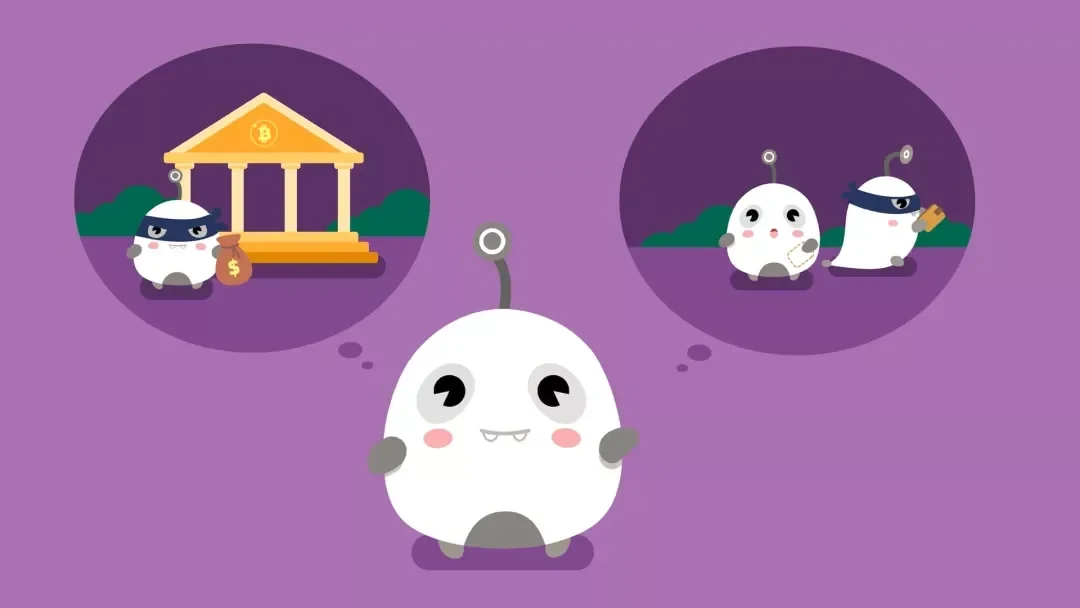
DeFi insurance refers to insurance protocols based on immutable, automatically enforceable smart contracts.
In simple terms, in traditional insurance, you first need to find a third-party insurance company, pay the corresponding fees, and then sign an agreement with it. The insurance company provides the guarantee, and if an event covered by the agreement occurs, the company processes the claim. Essentially, the entire process revolves around a third-party insurance company.

DeFi insurance removes the centralized insurance company entirely. Instead, a set of smart contracts written in code independently handles the insurance execution function. So, DeFi insurance is more like an execution tool written in code.
But this raises a new question! The essence of insurance lies in the transfer of risk—from those unwilling to bear it, to those willing and capable of bearing it. In traditional insurance, the third-party institution naturally serves as the risk bearer. With DeFi insurance being decentralized, who can bear this risk?
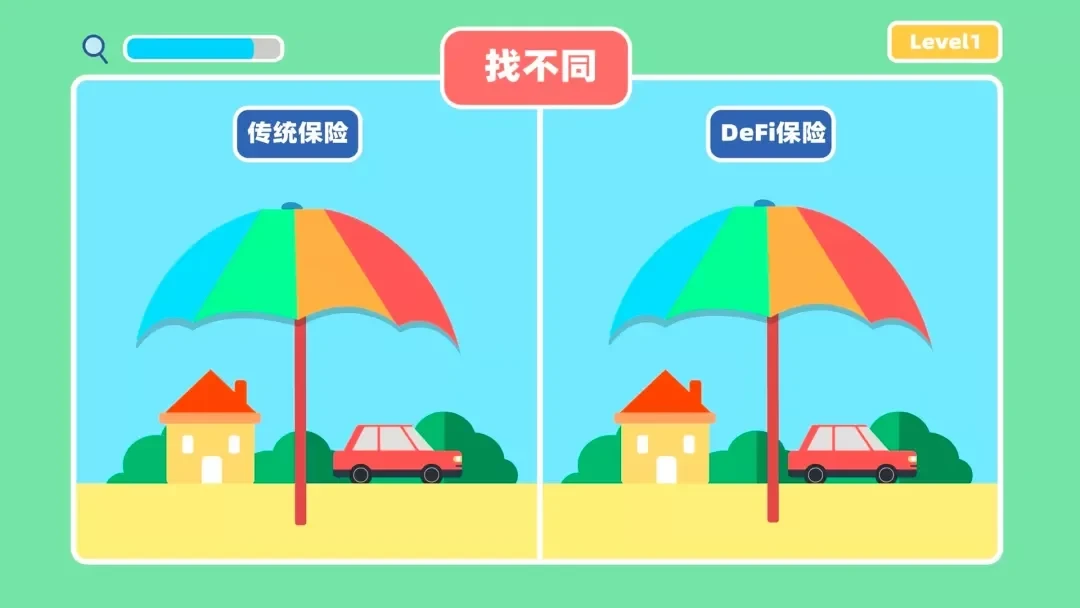
Let us explain how DeFi insurance specifically operates:
The business logic of DeFi insurance differs greatly from traditional insurance. Currently, most mainstream DeFi insurance adopts a mutual assistance model. It replaces the insurance company with a decentralized user organization that assumes the guarantee responsibility.
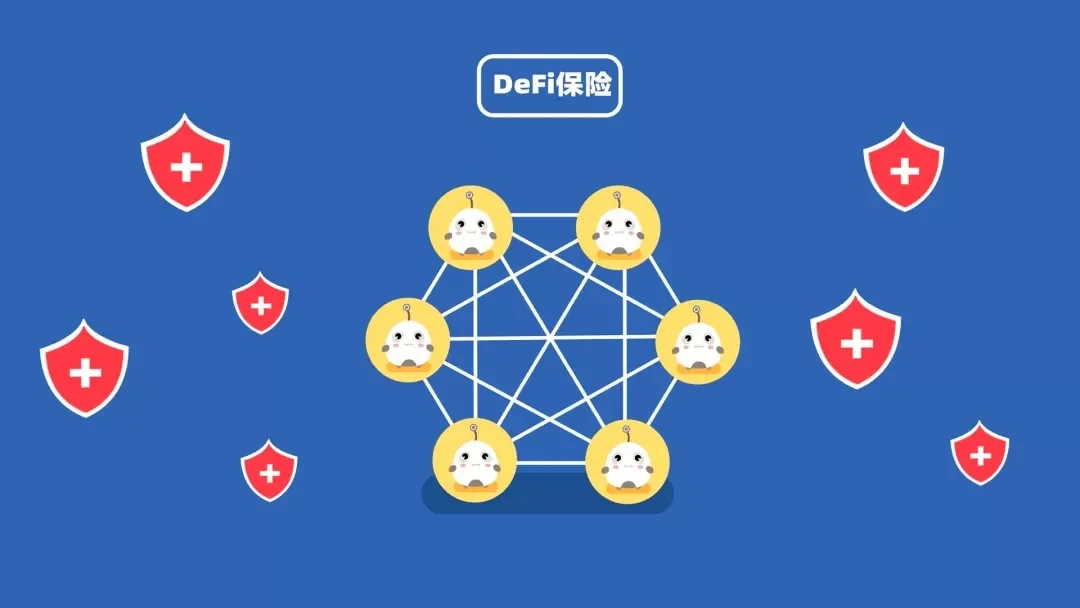
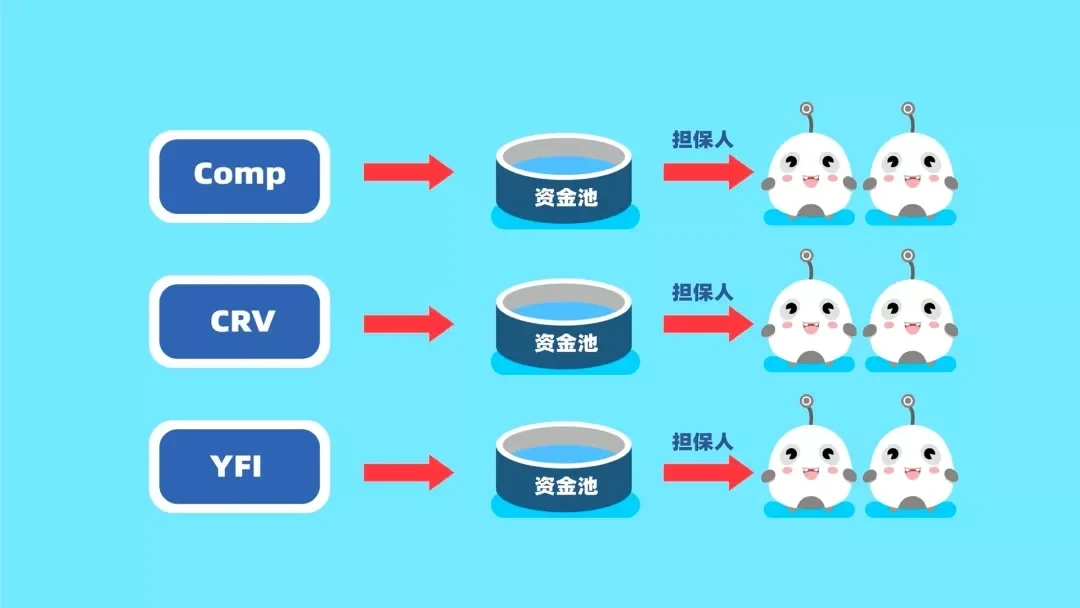
Like a regular insurance company, DeFi insurance covers many projects, and each project has a corresponding claim fund pool that anyone can join.
Anyone who contributes funds to the corresponding fund pool becomes a guarantor for that project. If the project later faces risks such as hacker attacks or project bugs, the risk and claims are shared collectively by everyone in the fund pool.
While guarantors bear the risk, they also receive correspondingly higher returns. As long as users purchase DeFi insurance for a certain number of days, everyone in the fund pool receives a share of the insurance premium, earning returns.
The entire process has smart contract programs handle execution tasks such as review, claims processing, and fund locking and release. So, rather than calling it DeFi insurance, it is more accurate to describe it as a peer-to-peer insurance organization.
Overall, DeFi insurance is indeed a major financial innovation. It opens up a new line of thinking—perhaps, with the passage of time, insurance companies may truly be disrupted one day, with everyone taking on this role and sharing both the risks and returns of insurance. Let us wait and see~
Special thanks to Xu Yinglong for his help and guidance on this episode.
Sina Weibo: @许英龙_sun1y
– END –
Disclaimer
This article may contain product information not applicable to your region. This article is intended to provide general information only and does not make any representations or warranties as to its accuracy or completeness. The views expressed in this article are those of the author alone and do not necessarily reflect the opinions of OKX. This article is not intended to provide, and should not be relied upon for, any investment recommendations, offers, or solicitations to purchase, sell, or hold digital assets, or financial, accounting, legal, or tax advice. Holdings in digital assets (including stablecoins) carry a high degree of risk and may fluctuate considerably, potentially becoming worthless. You should carefully consider whether trading or holding digital assets is appropriate for you in light of your financial situation. Please consult your legal/tax/investment professionals regarding your specific circumstances. Any information herein (including market data and statistics, if applicable) is provided for general reference purposes only. Whilst reasonable precautions have been taken in preparing these data and charts, we do not accept any responsibility for any factual errors or omissions expressed herein. © 2025 OKX. This article may be reproduced or distributed in full, or excerpts of 100 words or fewer may be used, provided that such use is non-commercial in nature. Any reproduction or distribution of the full article must also prominently display the following credit: "This article is copyrighted © 2025 OKX, used with permission." Permitted excerpts must cite the article title and include the source attribution, for example, "Article Title, [Author Name (if applicable)], © 2025 OKX". Some content may have been generated or assisted by AI tools. Reproduction or derivative use of this article for any other purpose is not permitted.
Show More
Recommended Reading
OKX Blockchain 60 Episodes | Episode 43: The Rise of the Mining Circle (Part 2) — The Rise of Bitmain
Hello everyone, I'm Xiao K. Today we're going to talk about: "The Rise of the Mining Circle (Part 2) — The Rise of Bitmain." In the previous lesson, we discussed two people who opened the door to capitalization and commercialization of the mining circle. One was "Pumpkin Zhang" — Zhang Nangeng, and the other was "Fried Cat" — Jiang Xinyu. Although together they ushered in the golden age of the mining circle, the person who truly elevated the mining industry to its peak was someone else—and his name is Wu Jihan.
2025年9月18日
OKX Blockchain 60 Episodes | Episode 2: Why Is Blockchain Called Blockchain?
"OKX Blockchain 60 Episodes" is a blockchain educational animation series jointly produced by OKX and Sina Tech. Aimed at users with zero knowledge of blockchain, through articles, animated videos, and other formats, it covers blockchain concepts from the perspectives of concepts, technology, and applications across five major sections and 60 knowledge points, presenting blockchain in a vivid and accessible way. The content of this episode was guided by Meng Yan, Deputy Dean of the Digital Assets Research Institute. In 2008, a global financial crisis erupted. On October 31st, "
2025年9月18日
OKX Blockchain 60 Episodes | Episode 16: What Is the PoW Consensus Mechanism?
"OKX Blockchain 60 Episodes" is a blockchain educational animation series jointly produced by OKX and Sina Tech. Aimed at users with zero knowledge of blockchain, through articles, animated videos, and other formats, it covers blockchain concepts from the perspectives of concepts, technology, and applications across five major sections and 60 knowledge points, presenting blockchain in a vivid and accessible way. The content of this episode was guided by Huang Fangyu, Co-founder of Wanyou Computing Power. Hello everyone, I'm Xiao K. Today we're going to talk about: "
2025年9月18日
OKX Blockchain 60 Episodes | Episode 51: 2019, Giants Enter the Market — Facebook's Cryptocurrency Dream
Previously, we discussed how in 2018, as blockchain was being hyped to an excessive boom, a massive de-bubbling process began, sending the entire industry into a winter. But danger and opportunity coexist—this cyclical downturn in the industry also happened to provide the perfect timing for international giants to enter the market. In February 2019, Wall Street financial giant JPMorgan Chase sounded the horn for international giants to enter the blockchain space, followed by Goldman Sachs, UBS, Citibank, Microsoft, and other giants.
2025年9月18日
OKX Blockchain 60 Episodes | Episode 7: What Does a Fork in the Blockchain Mean?
"OKX Blockchain 60 Episodes" is a blockchain educational animation series jointly produced by OKX and Sina Tech. Aimed at users with zero knowledge of blockchain, through articles, animated videos, and other formats, it covers blockchain concepts from the perspectives of concepts, technology, and applications across five major sections and 60 knowledge points, presenting blockchain in a vivid and accessible way. The content of this episode was guided by Boolean Fee Mo, an Austrian School economist. A fork in the blockchain can be described as a unique phenomenon in the blockchain network.
2025年9月18日
OKX Blockchain 60 Episodes | Episode 25: What Is the Lightning Network?
Hello everyone, I'm Xiao K. Today we're going to talk about: "What Is the Lightning Network"? The Lightning Network is a technology first proposed in 2015 by Joseph Poon and Thaddeus Dryja in a whitepaper, designed to solve Bitcoin trading congestion. This technology arose from a problem left over from Bitcoin's early days. Because when Bitcoin was first designed, it was created with a specific constraint.
2025年9月18日