2021 DAO Sector Review: Rising Towers, a Promising Future
PEOPLE+2. 17%
With the explosion of DeFi Summer in 2020, DeFi project designs have become increasingly complex, and the advantages of community governance architectures in many leading DeFi projects have become prominent. Protocols like Sushiswap and MakerDAO have brought the concept of DAO back into the spotlight.
In 2021, with frequent hot topics, the booms in NFT, GameFi, Web3.0, and the metaverse have expanded DAO application scenarios to various fields, spawning multiple vertical细分 sectors. The DAO sector as a whole has welcomed significant growth, with over 40 DAOs established throughout 2021. Since Q4, the pace of DAO establishment and development has accelerated, and many well-known DAO organizations and governance solutions have gained favor from capital, with frequent financing events.
As of December 29, the total assets under management (AUM) of 188 DAOs tracked by deepdao reached $12.1 billion. Compared to the first half of 2021, the scale of funds held by DAOs grew by 1422%. The cumulative number of organization members and token holders exceeded 16 million. Throughout this year, various DAO organizations initiated over 37,000 proposals and more than 1.7 million votes, demonstrating a thriving ecosystem.
In the final months of 2021, ConstitutionDAO sparked an idealistic "revolution" that led more people to discover the charm of DAO and join in. However, the subsequent influx of imitator projects and speculators tainted this revolution with hype and marketing.
Messari stated bluntly in its annual report that DAO is one of the most important structures in cryptocurrency, and it will change various aspects of the economy and politics, and may even change your life in the coming years. If 2020 was the year of DeFi and 2021 was the year of NFT, then 2022 will be the year of DAO.
On the last day of 2021, let's review DAO's past and look forward to its future together.
Trend 1: DAO ecosystem increasingly maturing, becoming an intersection point for various trends
Nowadays, DAO governance has basically become a standard feature for on-chain projects, with various vertical细分 projects emerging one after another. As an underlying design, DAO seems capable of combining with various trends, thus possessing infinite imagination space. Reviewing the ecological development of DAO in 2021, its applications have already covered development tools, services, social, media, creation, collection, and other fields, attracting attention and investment from global capital and insightful individuals. It can be found that DAO is positioned at the intersection of major hot sectors like NFT, GameFi, and DeFi. In a previous article "DAO Explained: The Gateway to DeFi, NFT, and GameFi", we provided a detailed introduction to this, so we won't elaborate further here.
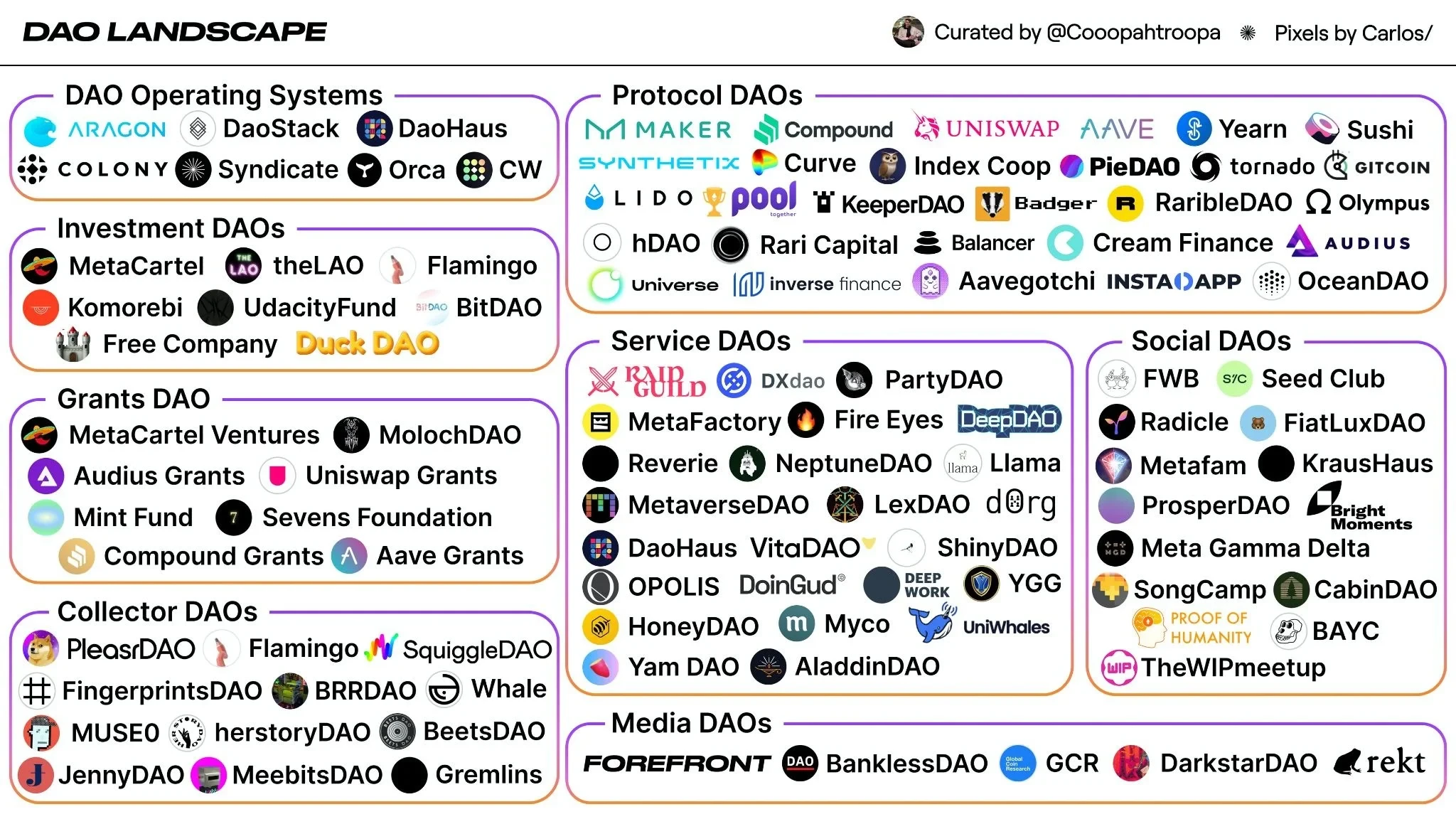
DAO ecosystem overview
Trend 2: Venture DAO challenges traditional venture capital model
In early December, centralized venture capital firm a16z became the center of controversy in the Web3.0 battle, while Sequoia Capital quickly responded, stating that the existing venture capital model is outdated and planned to restructure its investment architecture, even changing its Twitter bio to "Will help bold people build legendary DAOs," though it deleted this the next day. Venture DAO representing Web3.0 seems to be disrupting the traditional venture capital model.
DAO inherently carries financial attributes and investment preferences, and in theory can solve various problems in investment funds in traditional markets, such as lack of transparency and susceptibility to manipulation by decision-makers. Its flat organizational structure makes venture investment no longer the "power" of a few people, and allows "collective intelligence" to be maximized. Take FlamingoDAO for example: it has a network of 70 digital asset experts from different backgrounds, making it more suitable than traditional investment institutions for identifying opportunities in rapidly evolving ecosystems. Moreover, DAOs may have advantages over traditional investor peers due to the social capital and networks of all their members.
Furthermore, the DAO structure gives it advantages in flexibility and speed. It can raise large amounts of funds in a short time without being limited like traditional venture capital, such as ConstitutionDAO; it can also launch a new DAO for a popular NFT at any time, such as PleasrDAO. This year, with NFTs booming and frequently fetching astronomical prices, the advantages in flexibility and speed have led to particularly rapid development of NFT-focused Venture DAOs, such as Jenny DAO and Party DAO. Their main method is for DAO members to jointly build a treasury to collect and invest in NFTs.
Venture DAO infrastructure Syndicate Protocol announced in September this year that it completed a $20 million Series A financing round. Venture capital is investing in DAOs, while the form of these venture capital firms themselves is gradually transforming towards DAOs. Messari wrote in its year-end report: I'd bet that by 2025, one of the most active and largest AUM venture firms will be a DAO.
Trend 3: DAO operating systems are making it true "organizational Lego"
Since this year, various services for DAO operating systems have gradually improved. These projects provide standardized templates, frameworks, tools, and other underlying services for the creation and operation of DAOs, allowing users to easily launch a DAO with zero code.
DAO operating systems can be divided into DAO launchers and tools. DAO launchers are functional frameworks used to launch and run DAOs. Their specific functions can be divided into 6 major modules: proposal submission system, proposal discussion system, proposal passing system, resolution formulation module system, network service system, and gas fee system. Each major module can be further subdivided and implemented through different methods.
Most existing DAO launcher projects simultaneously cover all 6 modules, but differ in implementation methods, forming unique DAO governance suites. Representative projects include Aragon, Moloch, Elastic DAO, DAO Stack, and others. Compared to a year ago, DAO launchers have become more diversified and modular.
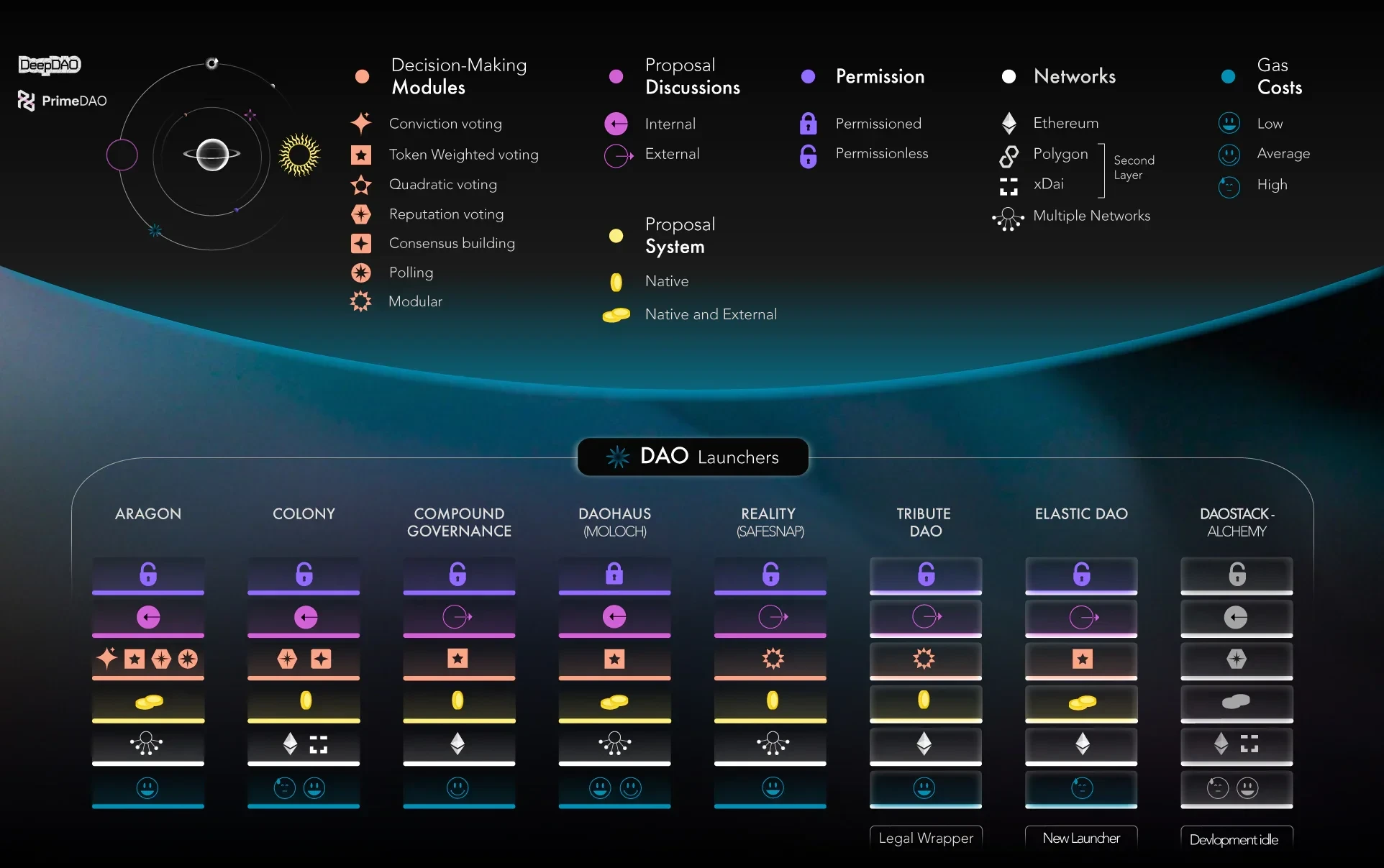
DAO launcher ecosystem overview Source: deepdao
DAO tools can help teams create customized functional modules or facilitate DAO participants in governance. Specific functions include asset management, governance tools, voting platforms, data and statistical analysis, identity identification, media and social tools, etc., which can cover the needs of more and more DAO creators and participants. Representative tools include Gnosis Safe, Tally, Snapshot, Collab Land, Parcel, IDX, and others. Among them, Gnosis Safe's custody volume and trading volume grew 3-fold in 2021; while authorization activity on Snapshot has significantly increased since September.
With the help of modular DAO launchers and tools, some emerging DAOs like Nns DAO allow their members to join any subset DAO, contribute to projects, move between platforms, or run different programs and applications. Meanwhile, the autonomous organization LAO has begun spawning other DAOs focused on specific areas of investment, becoming a DAO incubator. It can be foreseen that various DAOs will further explore open, interoperable, and composable new features, gradually solving the "DAO silo" problem and adapting to the diverse needs of existing or future projects, becoming true "organizational Lego" and Web3.0 infrastructure.
Trend 4: Opportunities and bubbles of DAO+meme
In the final months of 2021, some new species with very strong meme attributes appeared in the DAO sector, bringing the DAO concept further into the mainstream with impressive token prices.
In November, ConstitutionDAO rallied the power of PEOPLE to raise funds for auctioning a copy of the US Constitution. This idealistic organizational goal ignited the crypto community, and in 6 days, members raised $40 million from 17,437 donors globally, with donors able to receive PEOPLE tokens at a ratio of 1 ETH: 1 million PEOPLE.
DAO's decentralized autonomous vision perfectly aligned with the grand narrative of "returning the Constitution to the people." The community and consensus grew rapidly, with social networks and media extensively forwarding, outputting articles, and providing technical advice and resource support, much like a spontaneous online social movement. Everyone worked for a common ideal and symbol of freedom, seemingly having nothing to do with money.
Although ConstitutionDAO ultimately failed to successfully auction the Constitution copy, the auction itself was inspiring enough. After the auction failure, ConstitutionDAO opened refund channels and announced it would cease operations, but its token price experienced phenomenal volatility driven by community users, making the DAO concept momentarily the center of attention.
Subsequently, Free Ross DAO, Mask DAO, and Open DAO emerged one after another. These DAO organizations also aimed at fundraising or auctioning, and similarly carried declarations of rebelling against "centralized" institutions or even law enforcement that get people's blood pumping. After experiencing the ultra-high returns of PEOPLE, many investors were easily attracted by these stories.
But the speculative risks brought by profit-seeking immediately appeared. On December 16, the Free Ross DAO token FREE once surged to $0.015 after listing for trading. However, hype profit-takers quickly dumped their chips, and the next day FREE fell to around $0.0075, directly halving. The rebellious ideal fell apart in the face of reality, but this was undoubtedly a brave attempt.
Taking Open DAO as an example, its establishment was a counterattack against OpenSea's "embracing Web2.0 with Web3.0 users' money." Users banding together to issue their own tokens can, to some extent, force project teams to respond. It can be envisioned that in the Web3.0 world, traditional power structures are no longer applicable. All data is public on-chain, and anyone or organization can establish direct contact with high-value users. If project teams cannot remain competitive in serving users and sharing benefits, they may be replaced by latecomers. This is undoubtedly disruptive.
Trend 5: DAO will become a highly potential new asset class
However, through the bubbles and fantasies, returning to DAO itself as an organizational form, it actually has a much larger and more practical imagination space. Ultimately, DAO is a method of integrating individual power through smart contracts, and sets up a matching token incentive mechanism from the beginning of development. These governance tokens are essentially equivalent to stocks and equity, meaning DAO is inherently a global listed company, which also makes DAO tokens a highly potential asset class.
Meanwhile, token holders have the right to participate in project governance, and the economic benefits of tokens firmly bind token holders to the DAO organization. Under token economic incentives, DAO can achieve self-operation, self-governance, and self-evolution according to preset rules without being controlled by centralized institutions, thereby reducing human errors caused by centralized decisions or manipulation of investor funds.
For example, in May this year, the Uniswap community voted to change the original decision of the development team and investors, deploying Uniswap v3 first on Arbitrum, which had more complete infrastructure and smoother development progress. The collective decision-making of DAO achieved a correction of the project's overall development direction.
Of course, judging from the current actual operation process, most DAOs cannot yet fulfill their "decentralized" intent. The main reasons are:
(1) DAO infrastructure needs improvement
In the absence of complete collaboration frameworks and tools, decentralized collaboration will inevitably be inefficient with excessively high communication and collaboration costs. Therefore, most current DAOs can only handle relatively simple needs, such as voting on donations, fund management, etc. Taking governance-type DAOs of DeFi applications as an example, the rights and interests of members holding governance tokens are mainly reflected in initiating proposals and voting, while more advanced and complex collaboration like specific execution still needs to be completed by centralized development teams. In this situation, even community projects like Sushiswap that pioneered no VC and no pre-mining mechanisms have experienced multiple centralization negative events during their operation.
(2) Low member participation
Many DAO members holding governance tokens do not actually participate in governance. According to deepdao data, for example, Uniswap's total user count is over 200 times the number of voters, and BitDAO's voting users are only one-thousandth of total users. The emergence of hot DAO projects and tokens at the end of the year also made the market more impetuous. Many newly entered users don't have sufficient patience to truly understand DAO, and the power of the masses is thus simplified, becoming "limited to providing funds without getting personally involved."
If DAO governance tokens can truly become the "stocks" of the Web3.0 world, then DAO needs to operate as decentralized as possible according to Web3.0 requirements. This requires more refined institutional design, such as dividing more clear functional structures, adjusting incentive and elimination mechanisms, etc., to further explore its openness. At the same time, it needs to be matched with simpler, easier-to-use on-chain collaboration tools. Ultimately, it requires progress and implementation in all aspects of blockchain world infrastructure.
Conclusion
2021 was a year of rapid DAO development. Current DAOs have established a relatively complete ecosystem and found breakthrough points in fields like venture capital and NFT. We also see the infinite potential of DAO as an idealized organizational method and new asset class. With the further development of DAO modular operating systems, the DAO ecosystem will make further progress in interoperability and composability, thereby continuously expanding its boundaries.
The DAO sector is seeing rising towers with a promising future. We will witness together whether 2022 will become the year of DAO? What surprises will it bring us?
◆ 2021 Year-End Review Series Articles
|Public Chain Sector Review: A Hundred Flowers Blooming, Multi-Chain Co-Prosperity
|2021 Marks the First Year of NFT Explosion, These Three Trends Are Worth Watching
|Ethereum L2 Progressing Rapidly with Impressive Achievements
|OKX 2021 Year-End Report: Paying Tribute to the Golden Era of Blockchain
|DAO Sector Review: Rising Towers, a Promising Future
Disclaimer
This article may contain product-related content not applicable to your region. This article is committed to providing general information only and is not responsible for any factual errors or omissions contained therein. This article represents only the author's personal views and does not represent OKX's views. This article is not intended to provide any advice, including but not limited to: (i) investment advice or investment recommendations; (ii) offers or solicitations to buy, sell, or hold digital assets; or (iii) financial, accounting, legal, or tax advice. Holding digital assets (including stablecoins) involves high risk, may fluctuate significantly, and may even become worthless. You should carefully consider whether trading or holding digital assets is suitable for you based on your financial situation. For questions about your specific situation, please consult your legal/tax/investment professional. The information appearing in this article (including market data and statistics, if any) is for general reference only. Although we have taken all reasonable precautions in preparing these data and charts, we assume no responsibility for any factual errors or omissions expressed herein. © 2025 OKX. This article may be reproduced or distributed in full, or excerpts of 100 words or less from this article may be used, provided that such use is non-commercial. Any reproduction or distribution of the entire article must prominently state: "Copyright © 2025 OKX, used with permission." Permitted excerpts must cite the article name and include attribution, for example "Article Name, [Author Name (if applicable)], © 2025 OKX". Some content may be generated or assisted by artificial intelligence (AI) tools. Derivative works or other uses of this article are not permitted.
Show More
Recommended Reading
OKX Pay: Opening a New Era of Next-Generation Crypto Payments
The choice of tens of millions of users. Register OKX and enjoy ultimate trading experience and diverse wealth management products. A letter from OKX CEO Star: Today, we officially launch the first version of OKX Pay to over 100 million global users. As the industry's first payment application that truly achieves non-custodial and compliant integration, OKX Pay will be embedded in the OKX App, currently available to some markets, and expected to fully launch within months
March 22, 2026

New Chapter: Building Next-Generation Financial Infrastructure Together
The partnership between OKX and Intercontinental Exchange (ICE) is an important moment for OKX and equally significant for the evolution of the entire digital asset market. ICE establishes and operates some of the world's most important financial infrastructure, including the New York Stock Exchange and global derivatives and clearing platforms. ICE's strategic investment in OKX and joining our board reflects both parties' shared belief—digital asset technology will transform financial markets
March 10, 2026
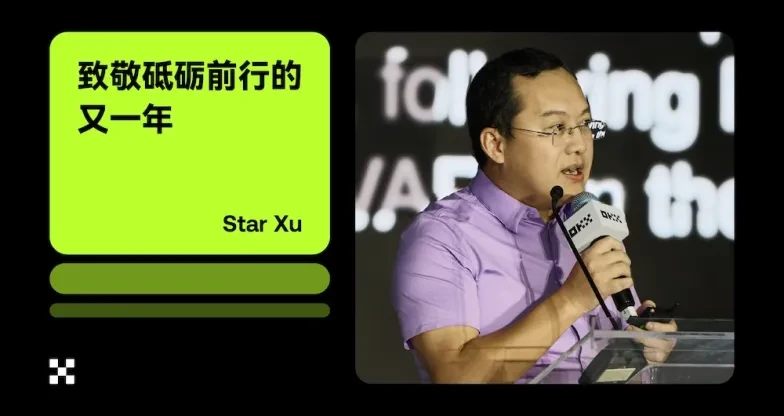
Paying Tribute to Another Year of Forging Ahead
As CEO of OKX and a builder who stays true to our original mission, I'm proud to review the remarkable growth and progress OKX has achieved this year. Despite many challenges, 2024 was a year of focus, innovation, and resilience. We not only expanded and optimized our products, but also made important progress in launching transparent and compliant localized businesses, while further strengthening our global management team. Notably, after experiencing
January 29, 2026

2025: Steady Progress Toward Financial Freedom Together
— Year-end letter from OKX Founder and CEO Star to global users "Financial freedom" is often misunderstood. It doesn't mean no rules, but rather having the right to choose while rules exist—and when the system is truly tested, it remains reliable and effective. This is exactly what we've been focused on throughout 2025. First, I want to extend my sincere gratitude to our global clients, partners, and regulatory authorities
January 16, 2026
OKX Officially Launches in Germany and Poland
Author: Erald Ghoos, CEO of OKX Europe Today is significant for OKX—and for crypto users across Europe. We have officially launched fully compliant centralized cryptocurrency trading platforms in Germany and Poland! For us, this is not just a geographical expansion, but a commitment to building the cryptocurrency future the right way: secure, transparent, and meeting local needs. If you're in Germany
October 21, 2025
Partnership Upgrade! OKX Partners with Standard Chartered to Expand European Market
On October 15, OKX Europe CEO Erald Ghoos stated that OKX is expanding its strategic partnership with Standard Chartered to the European Economic Area (EEA). Earlier this year, OKX first partnered with Standard Chartered in the UAE to launch the collateral mirroring program—a
October 15, 2025