Fed's First Rate-Setting Meeting of 2022 Imminent: Why Is the Market Greeting It with a Major Sell-Off?
January 25-26 (Eastern Time), the Federal Reserve's first rate-setting meeting of 2022 will be held; meanwhile, at 3 AM Beijing Time this Thursday, January 27, the Federal Reserve will hold a press conference to announce its interest rate decision.
Five days before this meeting, the market once again reacted strongly, with the entire cryptocurrency market greeting it with a major sell-off: according to OKX platform data, since last Friday (January 21), Bitcoin has led the entire cryptocurrency market in a continuous decline, with Bitcoin plummeting from a high of $43,497 to a low of $32,928, a drop of over $10,000, or 24.2%. If calculated from this cycle's high of $69,040, Bitcoin's price has already been "halved."
Led by Bitcoin, other crypto assets in the market have been decimated: second-ranked ETH fell from a high of $3,271 to a low of $2,158, a 34% drop. Other digital assets have almost all declined by over 30%, or even been cut in half, and most digital assets' prices are already lower than during the "5.19" crash.
As is well known, the biggest variable for all investment markets in 2022 is the United States' plan to begin raising interest rates. The reason why U.S. rate hikes are so feared is that in the past, once the United States entered a rate hike cycle, the entire world would face turmoil, especially all investment markets including the cryptocurrency market, which could face catastrophic consequences, and the "foundation" of the bull market could be wiped out.
So looking back at history, what reactions has the market given to each of the Federal Reserve's past rate-setting meetings? If the Federal Reserve begins raising rates this year, what kind of impact will it have on the market?
Fed Rate Hike Expectations Gradually Strengthening, Market Enters Endless Decline Mode
Since the Federal Reserve's rate-setting meeting last July first explicitly discussed reducing bond purchases, expectations that the Federal Reserve will begin raising rates have hung overhead like the Sword of Damocles, making every investor uneasy, and every slight movement causes panic.
This rate-setting meeting is being held against the backdrop of the continued reduction of bond purchases that began in last year's fourth quarter. Meanwhile, multiple Federal Reserve officials, including Fed Chair Powell, have continuously released tightening signals, suggesting that rate hikes will begin in March of this year. The federal funds rate futures market shows nearly 100% expectation for rate hikes to begin in March of this year, and the probability implied by CME futures markets of at least 4 rate hikes in 2022 has risen to over 70%, even beginning to price in the probability of a 50bp hike in March (something that hasn't happened in over 20 years).
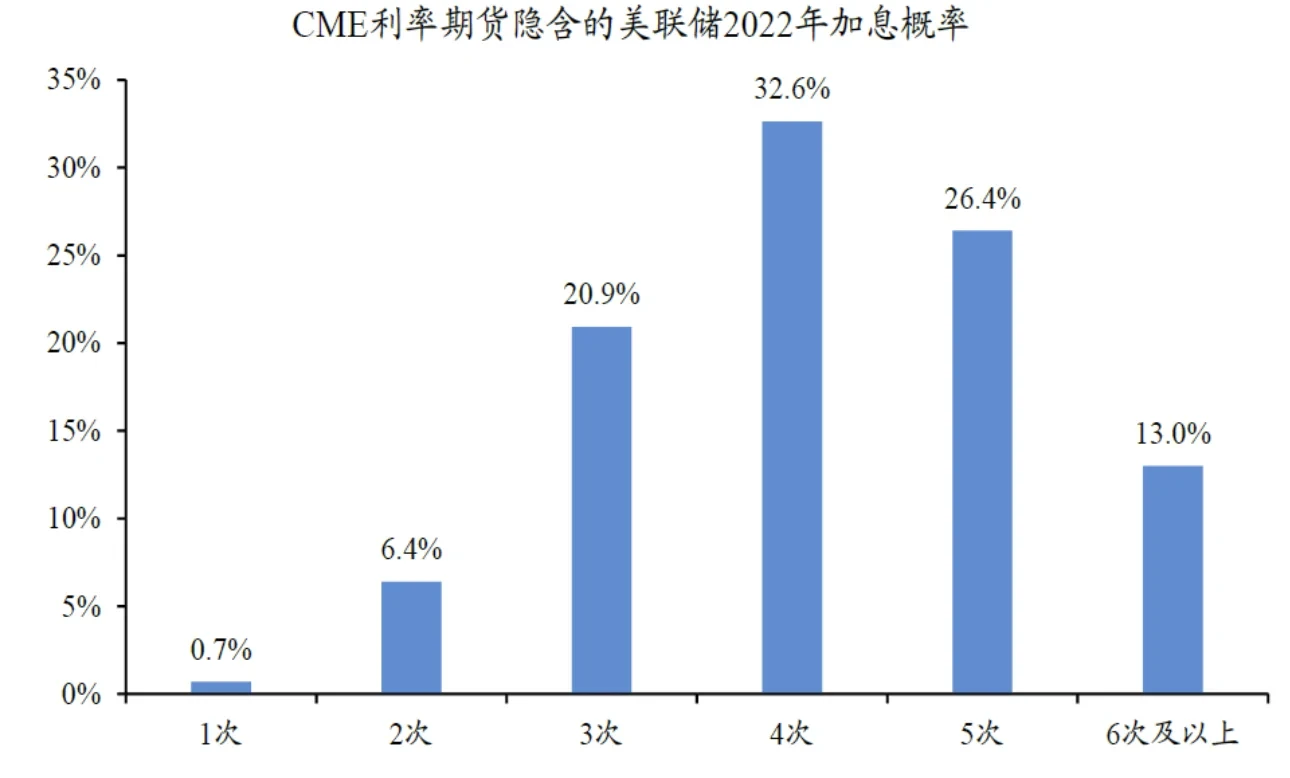
Source: CME, Sinolink Securities Research
Under such expectations, since the beginning of 2022, the cryptocurrency market has continued to oscillate lower: Bitcoin has fallen from an opening of $47,999 to a low of $32,928, a 31.3% decline, and ETH has fallen from an opening of $3,785 to a low of $2,158, a 43% decline. Other small-cap digital assets have not just been "cut in half" - it's been a bloodbath, returning to pre-bull market levels overnight.
In fact, not only has the cryptocurrency market been declining, but other global investment markets have also continued to fall. Taking U.S. stocks as an example, so far in 2022, the Dow Jones is down 5.7%, the S&P 500 is down 7.7%, and the NASDAQ is down 11.99%. Other countries' or regions' stock markets have also followed suit, including the Frankfurt DAX and Paris CAC40, which have both fallen in 2022, with Russia's RTS down as much as 12.1%.
It can be said that under Federal Reserve rate hike expectations, the world is in this together. Against this backdrop, investors need to focus on the following three major issues at this Federal Reserve rate-setting meeting.
First is the federal funds rate. At 3 AM Beijing Time this Thursday, January 27, the Federal Reserve will announce its interest rate decision. It is expected that this Federal Reserve meeting will keep the federal funds rate unchanged. The main goal of this meeting is to pave the way for March rate hikes and reducing the balance sheet.
Second is Federal Reserve Chair Powell's statement at the press conference. Powell may hint at a 25 or 50 basis point rate hike in March, or explain the prerequisites for a 50bp March rate hike by the Federal Reserve, and when the Federal Reserve will begin reducing its balance sheet.
Third is the Federal Reserve's description of the U.S. economy and inflation, which may set the tone for monetary policy for the rest of 2022. The Federal Reserve's previously released minutes from the December 2021 monetary policy meeting show that Federal Reserve officials are concerned about the spread of the COVID-19 Omicron variant, but against the backdrop of relatively sufficient U.S. economic recovery and continuously rising inflation levels, the Federal Reserve may raise the federal funds rate earlier and subsequently launch the balance sheet reduction process.
In summary, against the backdrop of accelerating monetary policy normalization, the Federal Reserve may continue to accelerate tapering at this meeting, potentially fully exiting QE as early as February. After the COVID-19 outbreak in 2020, accompanied by large-scale quantitative easing expansion, the Federal Reserve's total assets approached $9 trillion, equivalent to 43% of U.S. 2022 GDP (current prices), triggering a flood of liquidity.
The current cryptocurrency market bull market has largely benefited from this flood of liquidity. If this rate-setting meeting truly continues to accelerate tapering and exit QE early, it will be a major blow to the subsequent market. Conversely, the market may bottom out in the short term and begin a rebound.
Reviewing Bitcoin Historical Data: Must the Market Fall Before Every Rate-Setting Meeting?
As the saying goes, "ice three feet deep is not formed in a day." The market now reacts strongly to every Federal Reserve rate-setting meeting, which has much to do with the gradual tightening of monetary policy after past rate-setting meetings. Let's review how the market performed around the last 6 Federal Reserve rate-setting meetings, to see how the market step by step reached its current state, and from the perspective of "history repeating," see what insights it may offer for the present and future?
Due to space limitations, this section mainly covers Bitcoin's price trends around previous rate-setting meetings. All Bitcoin price screenshots below are from: OKX platform; screenshot time ignores the difference between Beijing Time and Eastern Time.
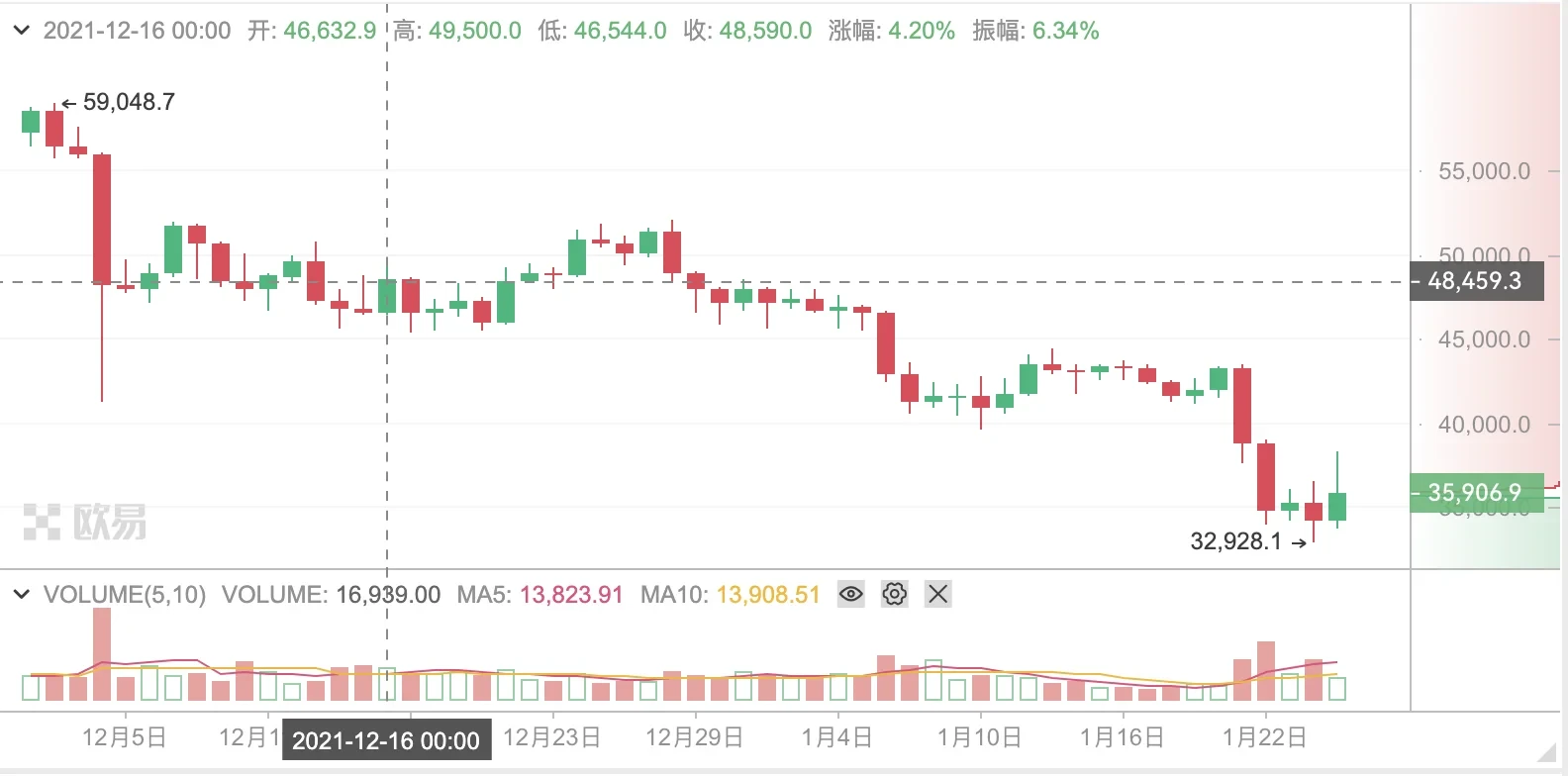
December 16, the Federal Reserve announced its interest rate decision and held a press conference. Before this meeting, the non-farm payrolls data in early December had already fallen short of expectations, causing Bitcoin to fall once, because the market expected that the upcoming rate-setting meeting might accelerate monetary policy tightening, so Bitcoin did not experience an "oversold bounce" but instead continued a slow decline.
Although the meeting ultimately made the expected accelerated tightening policy adjustment, making expectations materialize and the market briefly rebounding, the meeting statement removed references to transitory factors regarding inflation and allowing inflation to moderately exceed 2% for some time. Additionally, in the subsequently released dot plot, 12 of 18 Federal Reserve officials expected at least 3 rate hikes in 2022, which meant the market's subsequent trend remained mainly oscillating downward until this rate-setting meeting, when the market accelerated downward again.
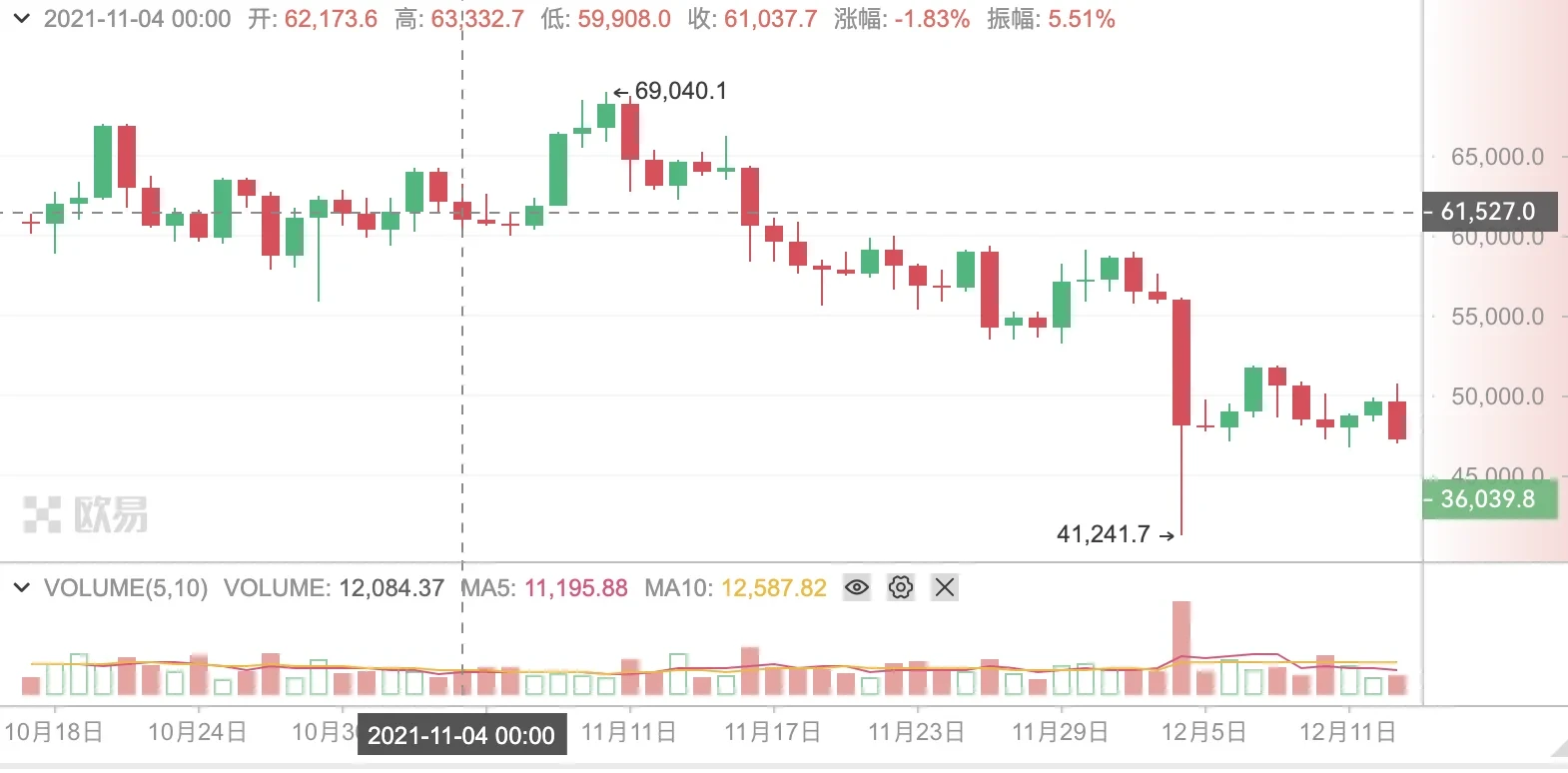
November 4, the Federal Reserve announced its interest rate decision and held a press conference. Before this meeting, the market already expected the Federal Reserve to reduce bond purchase amounts month by month, so it fell in advance, but also generally believed that the federal funds rate target range would remain unchanged at 0 to 0.25%, so the decline was limited. The meeting results ultimately met market expectations, and after the results were announced, the market reacted optimistically, with Bitcoin beginning to rebound and hitting a new all-time high. However, this meeting's beginning of bond purchase reductions also planted expectations for rate hikes, so after hitting its new high, Bitcoin turned downward and began endless decline mode.
September 23, the Federal Reserve announced its interest rate decision and held a press conference. Before this meeting, because Federal Reserve Chair Powell's speech was relatively hawkish, the market fell ahead of the meeting. Ultimately, this meeting did release clear signals and arrangements for monetary policy shifts, but the hawkish meeting statement had already been digested by the market, so the market instead showed a "bad news out of the way" trend, with Bitcoin beginning a significant rebound and subsequently stabilizing above the $60,000 mark.
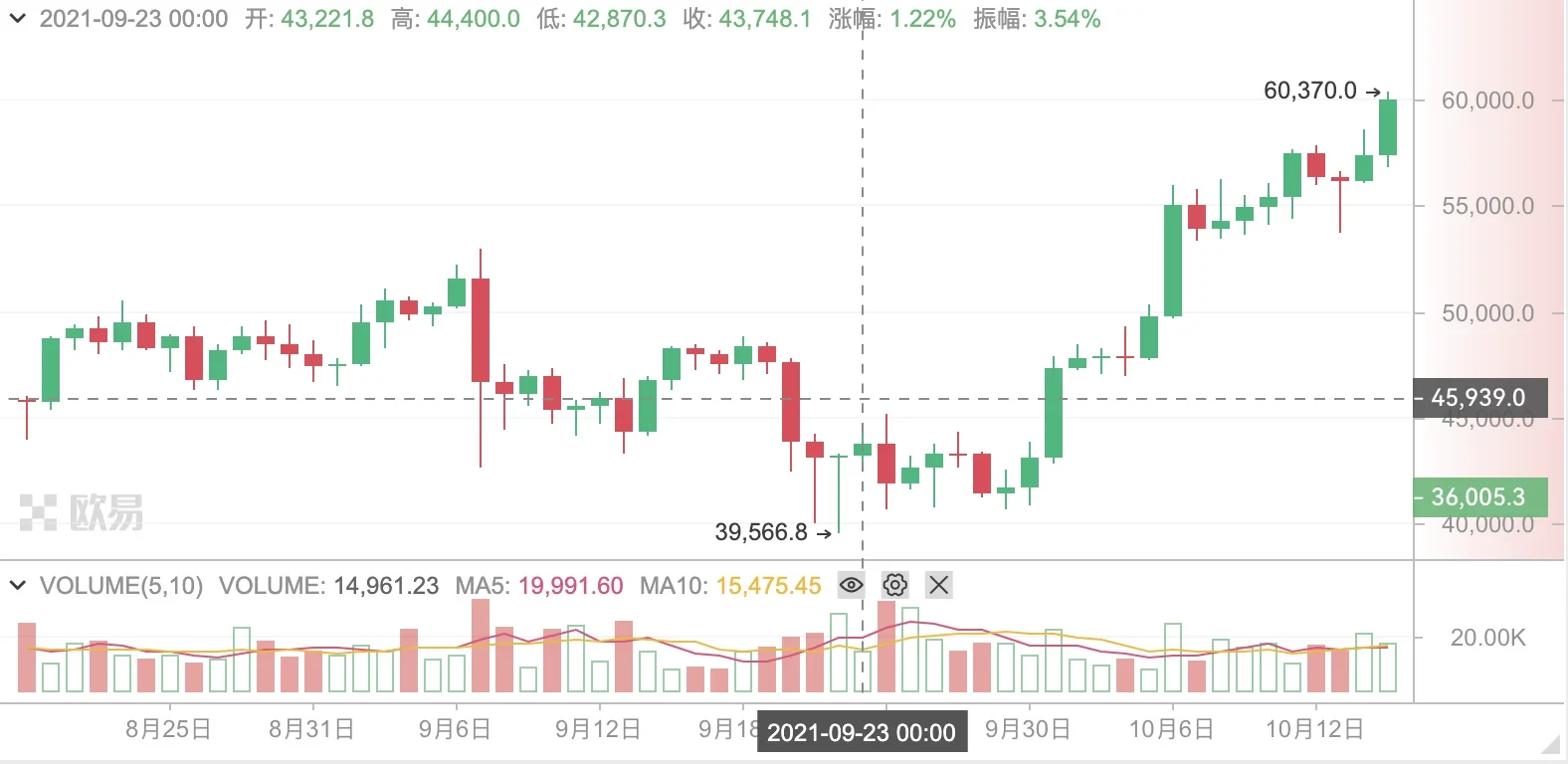
July 29, the Federal Reserve announced its interest rate decision and held a press conference. Before this meeting, Bitcoin had gradually recovered from the shadow of the "5.19" crash. Although the meeting's final statement was overall slightly hawkish, the Federal Reserve maintained both interest rates and bond purchase amounts unchanged. The market fell slightly after the meeting, then continued its rebound path.
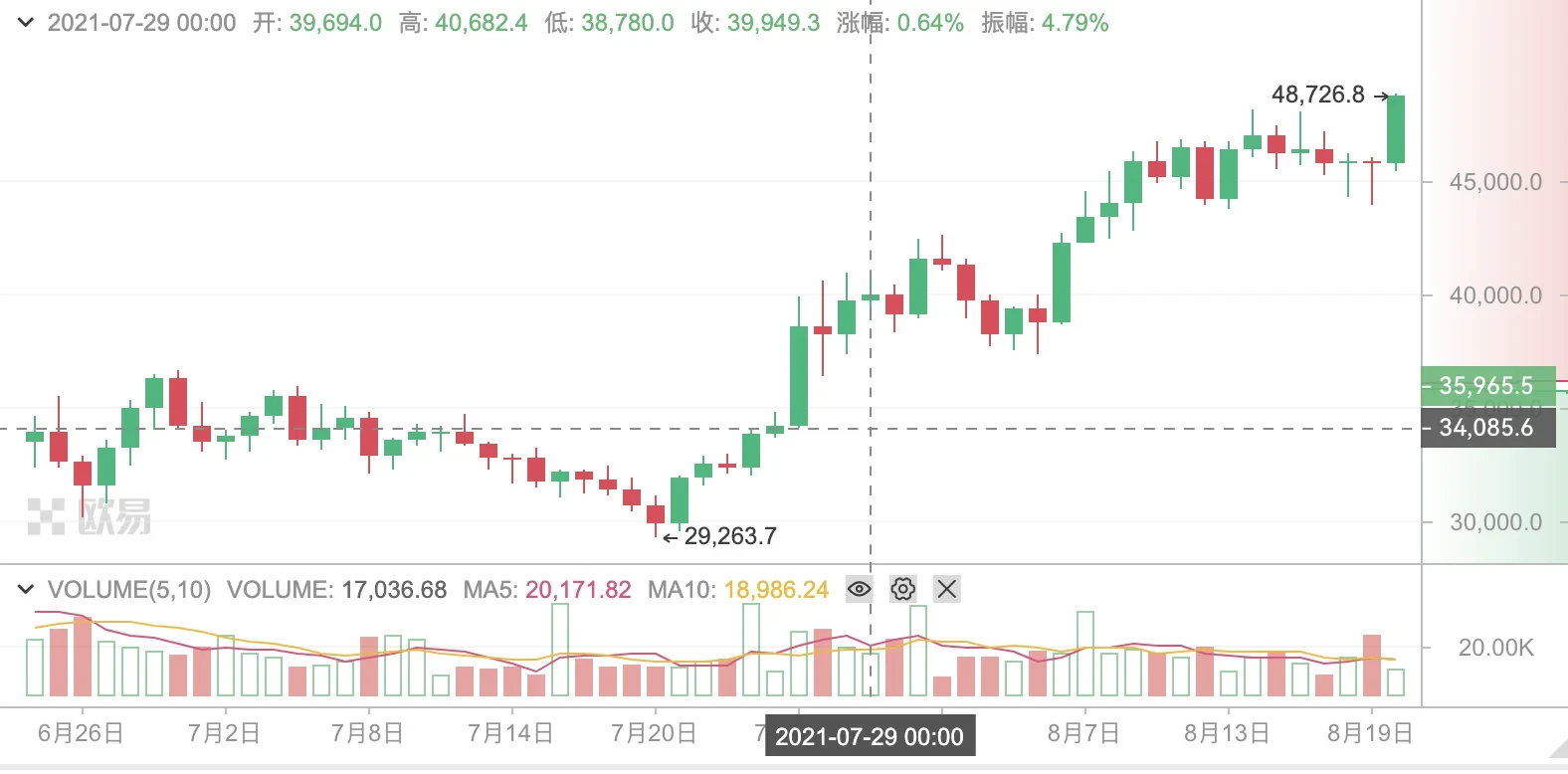
June 17, the Federal Reserve announced its interest rate decision and held a press conference. This meeting was overall hawkish. Although it met previous market expectations, the Federal Reserve began taking action to tighten monetary policy, such as raising both the overnight reverse repurchase rate and excess reserve rate by 5 basis points each. Additionally, the dot plot showed Federal Reserve officials expected two rate hikes by the end of 2023, with both timing and speed faster than before. This caused Bitcoin to continue falling after the meeting, with previous rebounds completely consumed.
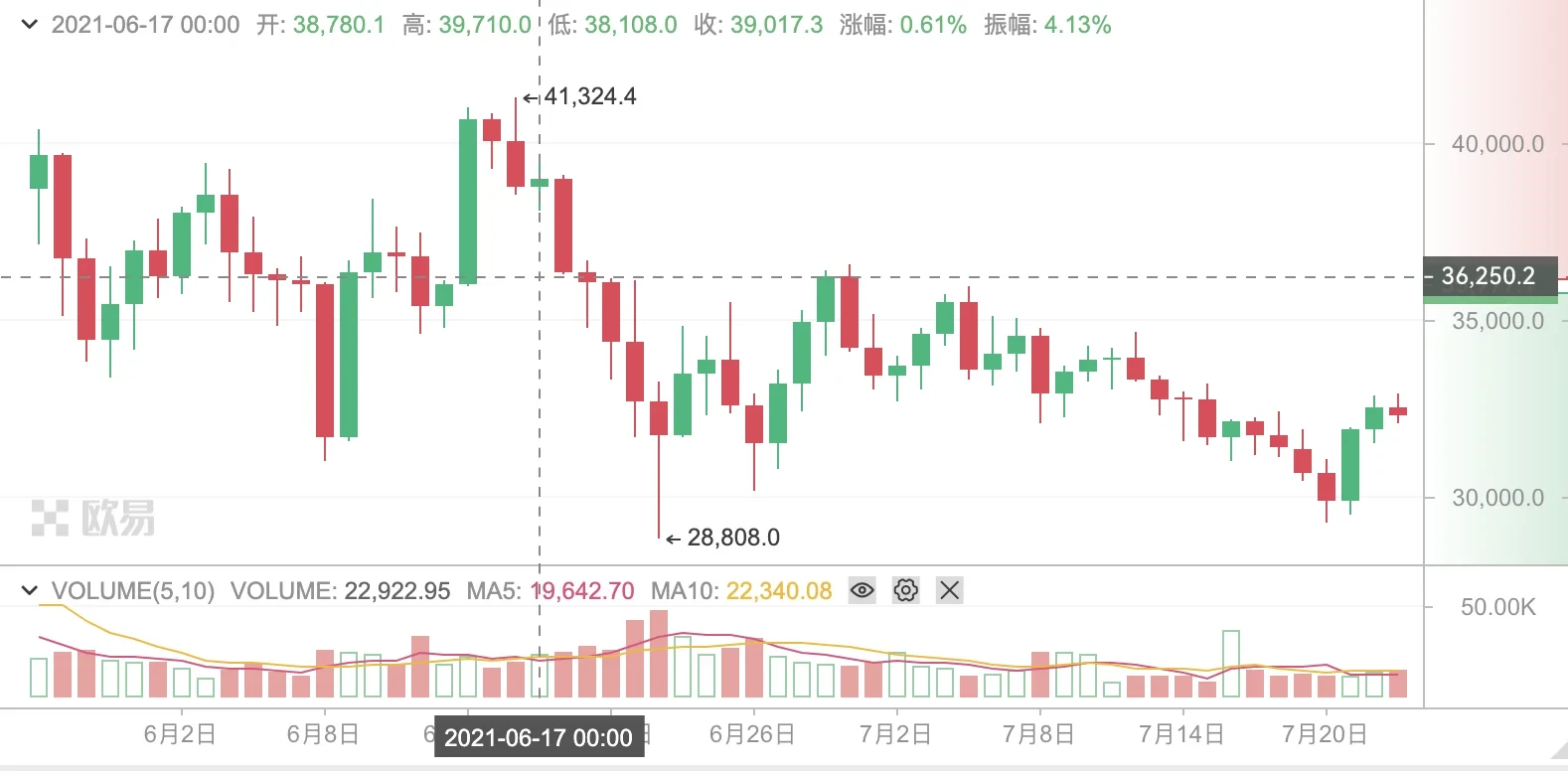
April 29, the Federal Reserve announced its interest rate decision and held a press conference. This meeting was overall still dovish, maintaining all three key rates and bond purchase amounts unchanged. So the market reaction was not significant, but due to well-known reasons, the market subsequently experienced the "5.19" crash.
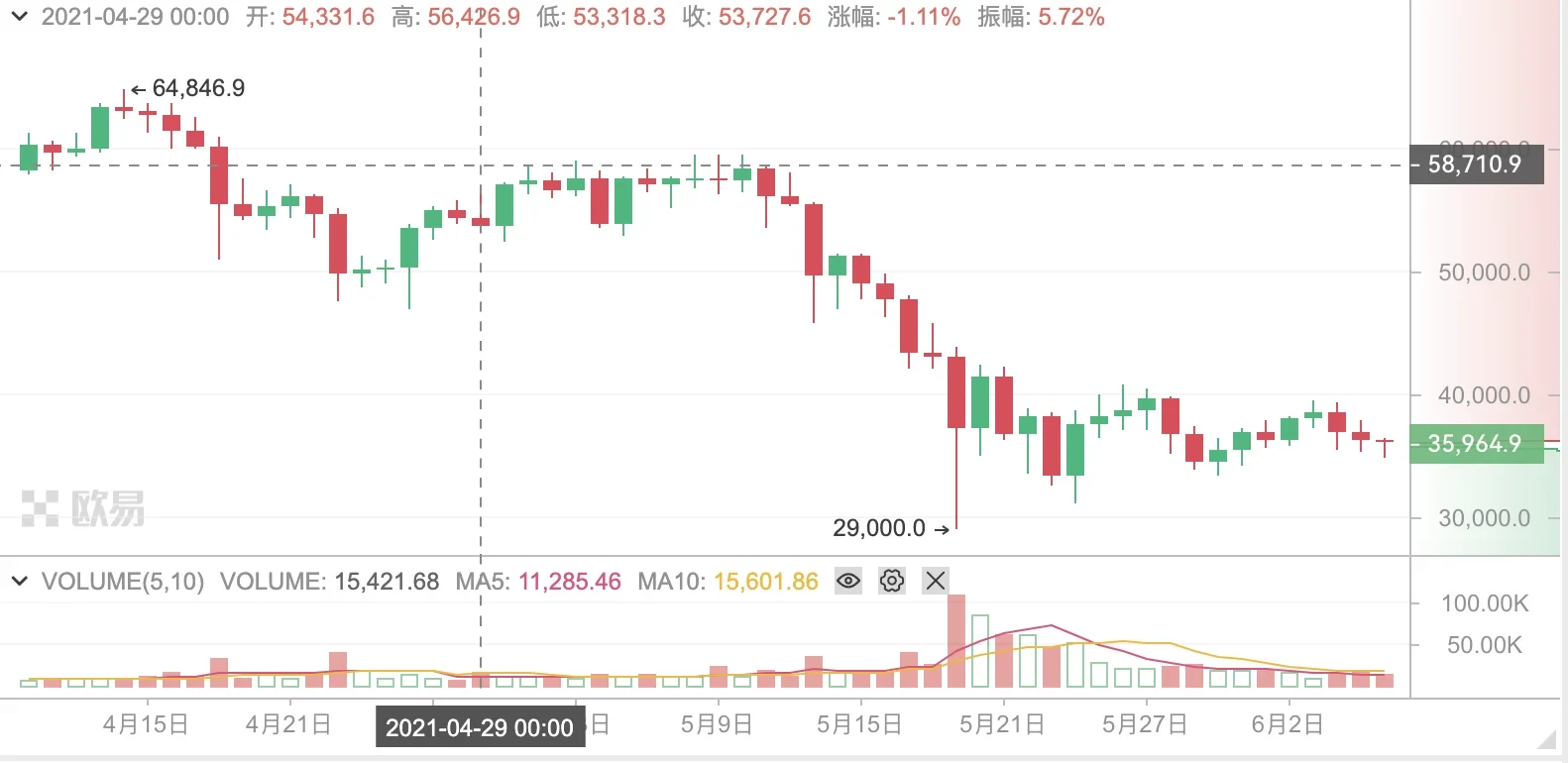
In summary, the market reacts around every Federal Reserve rate-setting meeting, with specific rises and falls and magnitudes varying based on market expectations and economic environment at the time. But regardless, Federal Reserve monetary policy, as the fundamental factor determining cryptocurrency market bulls and bears, is the most important financial event affecting market rises and falls. Subsequently, due to expectations of accelerated Federal Reserve bond purchase reductions and future rate hikes, investors need to pay extra attention to every upcoming Federal Reserve rate-setting meeting.
If the Fed Begins Raising Rates in 2022, How Will It Proceed and What Will Be the Impact?
The Federal Reserve has now repeatedly signaled plans to begin raising rates in March of this year, and the market has generally accepted that Federal Reserve rate hikes will arrive as scheduled. Although there is still some controversy over the timing of rate hikes, rate hikes themselves are basically a done deal. So if the Federal Reserve begins raising rates, how will it proceed? What impact will it have on the cryptocurrency market?
We have simply described the Federal Reserve's rate hike path: first stage, release clear signals of reducing asset purchases; second stage, gradually reduce bond purchase amounts; third stage, end QE; fourth stage, begin raising rates.
We are currently in the late second stage. Learning from history, the Federal Reserve may announce clearer policy guidelines at this meeting to pave the way for further monetary normalization. Looking back at the last Federal Reserve rate hike cycle, at the September 2014 rate-setting meeting before ending QE, the Federal Reserve published the "Policy Normalization Principles and Plans."
Of particular relevance to the present, at that time the Federal Reserve clearly stated that "the prerequisite for rate hikes is good economic conditions and outlook," and "after rate hikes, balance sheet reduction will proceed gradually and predictably, mainly by not renewing held U.S. Treasuries upon maturity." To more effectively manage policy expectations, the Federal Reserve may announce similar guidelines at the January meeting, at which point key changes in wording should be noted.
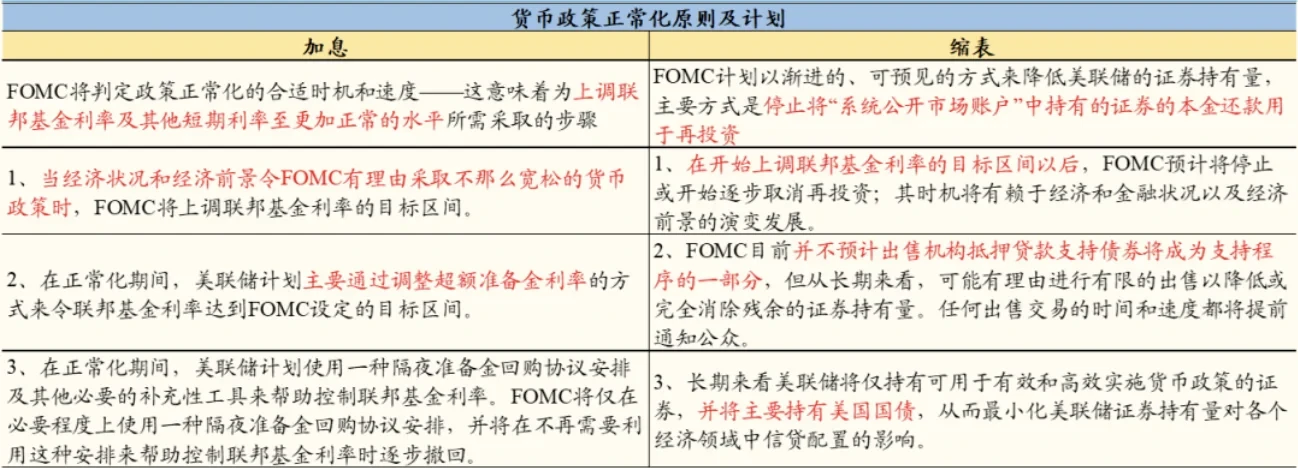
Federal Reserve's 2014 "Policy Normalization Principles and Plans" (Source: FED, Sinolink Securities Research)
Due to changes in the broader environment, unlike the last cycle which initiated rate hikes more than a year after ending QE, the interval between this round of Federal Reserve rate hikes and QE exit will be significantly shortened. Given that the Federal Reserve is still in the process of reducing purchases, the probability of a January rate hike is minimal, but it may provide clearer guidance on the specific timing and pace of rate hikes.
Meanwhile, the Federal Reserve may reiterate that balance sheet reduction will begin after the first rate hike, and proceed at a much faster pace than the last cycle. The Federal Reserve's December 2021 meeting minutes already explicitly stated that "almost all officials agreed to begin advancing balance sheet reduction after the first rate hike," and "the appropriate pace of balance sheet reduction may be faster than during the last normalization period."
We know that the basic logic of a bull market is the continuous inflow of new funds, and the Federal Reserve is the largest "source of liquidity." Looking back at the history of Federal Reserve rate hikes, we can find that: each rate hike has a short-term negative impact on Bitcoin, but long-term impacts may vary based on the economic environment at the time. As shown in the chart below, the 2017 bull market completed amid Federal Reserve rate hikes, but continued rate hikes in 2018 also turned the bull market into a bear market.
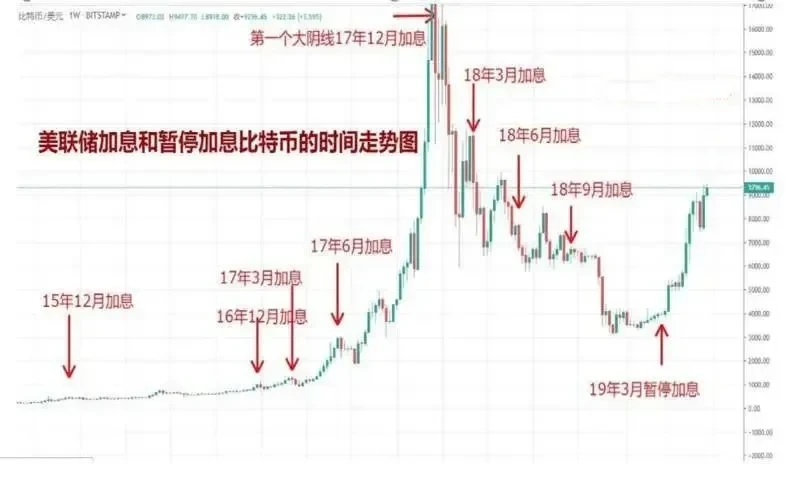
Bitcoin's First Two Halving Cycles and Federal Reserve Rate Hikes (Source: Bitfan)
However, specific circumstances require specific analysis. The current U.S. macroeconomic environment is vastly different from the last rate hike cycle, and the pace of Federal Reserve ending QE and raising rates will be different, resulting in different impacts on the market. One cannot simply apply outdated patterns. For specific details, please pay attention to the article OKX Academy will publish tomorrow at 18:00: "The 2017 Bull Market Also Had Rate Hikes - Will This Time Be Different?"
The most fundamental impact of U.S. rate hikes on the cryptocurrency market is the potential to create a short-term or long-term liquidity crisis. The root cause determining the length of such crisis is: at what pace will the Federal Reserve raise rates? But this question probably cannot be answered by the Federal Reserve itself, because Federal Reserve rate hikes also need to simultaneously observe changes in market liquidity to adjust their pace, without a fixed script.
However, looking at history, although there is no fixed script, there is a relatively fixed pattern. This pattern can be summarized into two stages: early stage is boiling a frog in warm water, late stage is a violent storm.
In the early stage when the tightening cycle begins, there will be a slow and small rate hike pace, ensuring global markets all operate at roughly the same rhythm, without front-running or jumping the gun. Meanwhile, one must combine the U.S. dollar index, U.S. Treasuries, and U.S. stock trends to comprehensively assess changes in global market liquidity. The impact on the cryptocurrency market may be short-term, as with the 2017 rate hikes mentioned above.
The late stage rate hike pace may be much more aggressive, even appearing extreme situations like raising rates once a month, or 100 basis points at a time. The key is seeing what state the market is in. This situation would rapidly drain market liquidity, causing a major crash, with a lasting impact on the cryptocurrency market, as with the 2018 rate hikes.
In summary, the market has relatively fully digested Federal Reserve rate hike expectations, but has relatively insufficiently digested balance sheet reduction expectations. Unlike the last cycle's slow balance sheet reduction, the Federal Reserve's balance sheet reduction this round may be faster and more forceful. However, 2022 may not necessarily be the crash year, because the transmission of rate hike impacts still needs time, and dollar inflows have not yet ended. Moreover, the bursting of bubbles often begins suddenly when people's expectations start turning to euphoria. Currently, the market still seems too cautious about upcoming rate hikes.
History has proven that Federal Reserve rate hikes have a huge impact on the market, with almost every rate-setting meeting causing major market volatility. Regardless of the past, before and after each upcoming meeting, attention must be paid to risk control.
Finally, this article is for reference only and does not constitute investment advice. The market involves risks, so please invest cautiously.
Disclaimer
This article may contain product-related content not applicable to your region. This article is intended only to provide general information and is not responsible for any factual errors or omissions herein. This article represents only the author's personal views and not those of OKX. This article is not intended to provide any recommendations, including but not limited to: (i) investment advice or investment recommendations; (ii) offers or solicitations to buy, sell, or hold digital assets; or (iii) financial, accounting, legal, or tax advice. Holding digital assets (including stablecoins) involves high risk, may fluctuate significantly, and may even become worthless. You should carefully consider whether trading or holding digital assets is suitable for you based on your financial situation. Please consult your legal/tax/investment professional regarding questions about your specific situation. Information appearing in this article (including market data and statistics, if any) is for general reference only. Although we have taken all reasonable precautions in preparing these data and charts, we assume no responsibility for any factual errors or omissions expressed herein. © 2025 OKX. This article may be reproduced or distributed in its entirety, or excerpts of 100 words or less from this article may be used, provided such use is non-commercial. Any reproduction or distribution of the entire article must also prominently state: "Copyright © 2025 OKX. Used with permission." Permitted excerpts must cite the article name and include attribution, such as "Article Name, [Author Name (if applicable)], © 2025 OKX." Some content may be generated or assisted by artificial intelligence (AI) tools. Derivative works or other uses of this article are not permitted.
Show More
Recommended Reading
OKX Pay: Opening a New Era of Next-Generation Crypto Payments
The choice of tens of millions of users. Register for OKX to enjoy the ultimate trading experience and diverse wealth management products. A letter from OKX CEO Star: Today, we officially launch the first version of OKX Pay to over 100 million global users. As the industry's first payment app to truly achieve non-custodial and compliant integration, OKX Pay will be embedded within the OKX App, currently available in select markets, expected to fully
March 22, 2026

New Chapter: Building Next-Generation Financial Infrastructure Together
OKX's partnership with Intercontinental Exchange (ICE) is an important moment for OKX and equally significant for the evolution of the entire digital asset market. ICE establishes and operates the world's most important financial infrastructure, including the New York Stock Exchange and global derivatives and clearing platforms. ICE's strategic investment in OKX and joining our board reflects both parties' shared belief that digital asset technology will transform financial markets
March 10, 2026

Saluting Another Year of Forging Ahead
As CEO of OKX, and as a builder who remains true to our original mission, I am proud to look back on OKX's extraordinary growth and progress this year. Despite numerous challenges, 2024 has been a year of focus, innovation, and resilience. We have not only expanded and optimized our products, but also made significant progress in launching transparent and compliant localized businesses, while further strengthening our global management team. Notably, after experiencing
January 29, 2026

2025: Steady Progress Toward Financial Freedom Together
— Year-end Letter from OKX Founder and CEO Star to Global Users "Financial freedom" is often misunderstood. It doesn't mean no rules, but rather having the right to choose within the framework of rules—and when the system is truly tested, it remains reliable and effective. This is exactly what we focused on throughout 2025. First, I want to extend my sincere gratitude to our global clients, partners, and regulatory authorities
January 16, 2026

OKX Officially Launches in Germany and Poland
Author: Erald Ghoos, CEO of OKX Europe Today is significant for OKX—and for cryptocurrency users across Europe. We have officially launched a fully compliant centralized cryptocurrency trading platform in Germany and Poland! For us, this is not just a geographic expansion, but a commitment to building the cryptocurrency future the right way: secure, transparent, and meeting local needs. If you're in Germany
October 21, 2025

Partnership Upgrade! OKX Partners with Standard Chartered Bank to Expand European Market
On October 15, OKX Europe CEO Erald Ghoos stated that OKX is expanding its strategic partnership with Standard Chartered Bank to the European Economic Area (EEA). Earlier this year, OKX first partnered with Standard Chartered Bank in the UAE to launch the collateral mirroring program—a
October 15, 2025