Chia Raises the "Green, Compliant" Banner — Will the Market Buy It?
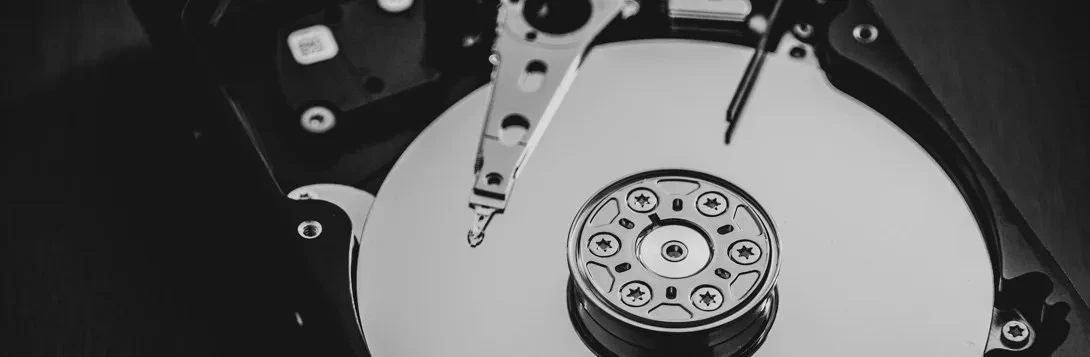
Recently, enterprise hard disk prices have surged. It is understood that before the price increase, ordinary 6T, 8T, and 16T enterprise hard disks were sold at approximately 820 yuan, 1,249 yuan, and 3,300 yuan respectively. As of April 22, the JD.com platform shows Western Digital 6T enterprise hard disks starting at 1,699 yuan, 8T enterprise hard disks at 2,999 yuan, and 16T at 5,999 yuan — prices have roughly doubled on average.
The sharp rise in hard disk prices in a short period has been attributed to the launch of the Chia mainnet and the start of its farming operations. Unlike crypto assets that use computational power for mining, Chia uses idle disk space on hard drives for farming (Note: Chia uses "farming" to refer to "mining").
Founded in 2017, Chia advocates for environmentally friendly cryptocurrency, hoping to reduce energy consumption while ensuring security through its proposed Proof of Space and Time mechanism, thereby achieving "green mining." Chia explicitly stated in its whitepaper its commitment to a compliance path of "embracing regulation and seeking a stock market listing," aiming to become a global payment settlement network system and enable large-scale on-chain application expansion for enterprises, especially financial institutions.
Backed by a star team led by Bram Cohen, founder of BitTorrent, and investment from renowned institutions such as a16z and Greylock, Chia's mainnet launch was met with enthusiastic response. Although it has not yet listed on any exchange, it has already attracted significant attention. This article will take this opportunity to explore Chia's project features, return prospects, and other key issues.
"Green Bitcoin"
According to official information, Chia was founded in August 2017 with the aim of developing a platform that optimizes blockchain and smart contract trading. Chia uses a brand-new consensus mechanism — Proof of Space and Time — allowing users to farm by contributing idle hard drive space. Compared to Bitcoin mining, which consumes massive amounts of electricity and specialized equipment, Chia is considered a greener and more environmentally friendly crypto project.
In the view of Chia founder Bram Cohen, the concept behind Satoshi Nakamoto's construction of the Bitcoin consensus mechanism was correct, but since major players control the vast majority of computing power, it has not only reduced the degree of decentralization to a considerable extent but also caused enormous resource waste. Therefore, Chia's Proof of Space and Time mechanism can achieve low-energy farming while ensuring security. To further embody the environmental philosophy, Chia replaced "mining" with "farming" in its system design.
The Proof of Space and Time mechanism consists of two parts: Proof of Space and Proof of Time. Proof of Space can be viewed as a "method of proving that you have unused certain storage on a hard drive." Users can install software to "plot" unused space on their hard drives; the software will generate and store cryptographic data sets on disk as plots, and these users become "farmers." Unlike miners, when a new block is broadcast on the Chia blockchain, farmers scan their plots to see if they have a number close to the new challenge derived from the previous block. Proof of Time is implemented through a Verifiable Delay Function (VDF), which requires a certain amount of time to compute but verifies very quickly. The key idea behind VDF is that it requires sequential computation, so having many parallel machines or CPUs/GPUs/ASICs (as in proof-of-work mining) provides no benefit, minimizing electricity waste.
To farm Chia, farmers first need to create one or more plots — files that occupy hard drive space. This process is called plotting. Plot creation requires time and CPU; the larger and more numerous the plots, the greater the computing power, meaning a higher chance of winning a block. Simply put, Chia requires farmers to plot idle hard drive space before farming, and then farmers search for the optimal solution for block winning within the already-plotted files. Therefore, the higher the total capacity of plotted files as a proportion of the entire network's total capacity, the easier it is to win blocks, and the higher the corresponding farming returns.
Pursuing Compliance, Embracing Regulation
Since the goal is to become a global payment settlement network system to meet the needs of sovereign nations, financial institutions, and large enterprises, in addition to being green and environmentally friendly, Chia seeks compliance and a stock listing as its method to enhance the credibility and regulatory certainty of Chia's business among governments, financial institutions, and enterprises. Therefore, Chia tokens have not undergone any private or public sale. The Chia network will use its native cryptocurrency to operate a payment settlement system, with the ticker XCH. XCH is viewed as a useful payment tool rather than an investment opportunity, so early investment institutions received equity in the Chia company and do not hold XCH.
Regarding XCH distribution, the whitepaper mentions that to honor Satoshi Nakamoto, the founding team will strategically reserve 21 million XCH, i.e., pre-mining 21 million XCH. Initially, 64 XCH are released every 10 minutes, and mining rewards halve every 3 years until they reach 4 XCH per 10 minutes (Year 13) and remain constant thereafter.
Chia's mainnet launched on March 19, 2021 at 4:00 PM (UTC). For the first six weeks after launch, only farming was allowed without transfers, aiming to complete initial token distribution. The transfer function is expected to open as early as May 3 (Beijing time), at which point 406,000 XCH will be in circulation in the market.

As shown in the chart above, it would take 22 years of farming for the mined XCH to match the 21 million XCH in reserves set aside by the official team. Therefore, the market pays particular attention to the reserves controlled by the official team. Based on the information disclosed in the Chia whitepaper, the following key information can be determined:
- The company will not sell its reserves, nor will it enter into any futures contracts that permit or require the company to transfer XCH to third parties in the future;
- Chia's investors invested in equity and do not hold XCH tokens. However, if the company fails to complete a stock listing within three years from the mainnet launch date, or if the total market cap remains below 65% of the actual value of XCH holdings for 30 days after listing, investors have the right to redeem their invested amount at the then-current market price of XCH. However, investors can only recover the market value of their initial investment amount at that time and will not receive any returns;
- Chia will not distribute XCH to employees of the company, equivalent to independent contractors, senior officers, or directors;
- The use of strategic reserves is subject to a board of directors vote. Approval requires both a majority of directors and a majority of independent directors. The current board has three members, including one external independent director. The board is seeking to add two more external independent directors, meaning future use of reserves will require approval from two external independent directors;
- Any changes to the rules governing the use of strategic reserves will be announced to the public at least 90 days in advance;
- The company will not use its held Chia for stock buybacks, dividends, external investment, or similar actions until it submits a listing application;
Chia's self-positioning is as a software service company that generates revenue by providing software services and technical support. That is, the company's operating system product is open-source and free, but complex commercial product customization for industry users requires service and support fees. Chia has three purposes for going public:
First, to enhance its credibility. Going public can effectively boost B-end customer confidence and promote Chia's applications in the traditional world. Adopting traditional corporate governance methods can also impose restrictions and oversight on the company's financial transparency, including the use and management of strategic reserves, giving confidence to XCH holders in the secondary market;
Second, Chia listed shares serve an ETF-like function. As XCH rises and falls, buying this stock is, to a certain extent, buying a share of XCH tokens, providing an entry point for traditional users to invest in XCH and expanding Chia's user base;
Finally, to act as a price stabilizer. Chia will form two prices in the future: the XCH price on cryptocurrency trading platforms and the stock price of the listed company. These two prices will be correlated. When the two diverge, arbitrageurs will begin arbitraging, which serves to reduce price volatility — this aligns perfectly with Chia's vision of serving as a global payment settlement network system.
To ensure commercial applications and customizability, Chia independently developed a new programming language called Chialisp. The Chia team stated that Chialisp is safe, concise, and better enables the building of smart contract trading. It is specifically designed to meet the needs of banking, payment, and financial applications. Currently supported smart contract trading includes atomic swaps, authorized payees, recoverable wallets, multi-signature wallets, and limit orders.
XCH Listing Imminent, Short-Term Price Faces Greater Volatility
Chia's star team, its investment institutions, and its core green and compliant concepts are its greatest advantages. The recent frenzy over hard drives and rising prices demonstrate the project's popularity. Therefore, barring unforeseen circumstances, with the opening of Chia's transfer function, XCH will list on various exchanges in May. Since the official team has clearly stated that the use of reserves is very cautious and large institutions do not hold XCH, there is no selling pressure in the market for now — any selling pressure would only come from early farmers selling some XCH to raise funds. Therefore, XCH may experience significant volatility. As of April 22, the OTC price of XCH was 120 USDT. However, in the face of Chia's popularity, many people have also come forward to warn about the risks it faces.
First, although Chia has proposed a "green" concept that does not require massive electricity consumption, it causes significant wear and tear on hard drives, especially solid-state drives. As we mentioned earlier, to farm Chia, farmers need to create plots before farming, a process called plotting. Since plotting requires long periods of continuous high-speed read/write operations, solid-state drives are needed for speed, and their lifespan is tied to data volume — a solid-state drive may need replacement after approximately 3 months of use. Of course, solid-state drives are only used for caching during the plotting process; the final plotted files need to be stored permanently on hard drive space, which requires high-capacity mechanical hard drives. Therefore, if the Chia network flourishes, it will inevitably face criticism of "waste" and "driving up hard drive prices." Furthermore, due to people's profit-driven nature, if farming XCH returns are substantial, the emergence of large-scale Chia farms similar to ASIC mining operations is only a matter of time. Especially since the current hard drive purchasing has already shown accumulation by large players, we should also question whether Chia's vision of "decentralization" can truly be realized.
Second, due to the project's high popularity, Chia may list on exchanges at a relatively high price, but whether the price will be sustained remains uncertain. Since Chia's farming model is relatively simple and the primary applications are payment and trading, XCH prices will directly affect farmers' returns. Once the price drops, there may well be a phenomenon of excess computing power.
Third, Chia's vision is overly ambitious, and the dual stock-and-token structure will be extremely difficult to implement. Additionally, its positioning is B2B. Although the enterprise application market is larger than the direct-to-consumer market, the upfront expenses and investments are also more costly and time-consuming. The last project to propose a similar vision was EOS, which currently seems to have stalled. Chia has promised investors that if it fails to successfully list within three years or if the listing falls short of expectations, investors can redeem a certain amount of XCH. However, the specific redemption rules have not been clearly disclosed, so the market will have a significant selling pressure expectation within three years. In summary, Chia's environmentally friendly and green farming philosophy, combined with its path of embracing regulation and pursuing compliance, aligns with mainstream development. Its ambition to become a global payment settlement network system will drive the founding team to work tirelessly toward this goal. The dual stock-and-token structure concept is bold, and once implemented, it will connect blockchain with the traditional world and serve as a model for other projects in the space. However, given that its vision has not yet been realized, short-term market FOMO sentiment is high, the number of participants is surging, competition is fierce, and the rise in hard drive prices has also increased the cost of entry — therefore, one should act rationally and fully consider investment risks before making any decisions.
Disclaimer
This article may contain product-related content that does not apply to your region. This article is only intended to provide general information and does not accept responsibility for any factual errors or omissions herein. This article represents only the author's personal views and does not represent OKX's views. This article is not intended to provide any advice, including but not limited to: (i) investment advice or investment recommendations; (ii) offers or solicitations to purchase, sell, or hold digital assets; or (iii) financial, accounting, legal, or tax advice. Holding digital assets (including stablecoins) involves a high degree of risk and may fluctuate significantly or even become worthless. You should carefully consider whether trading or holding digital assets is appropriate for you based on your financial situation. For questions about your specific circumstances, please consult your legal/tax/investment professional. The information contained in this article (including market data and statistics, where applicable) is provided for general reference only. Although we have taken all reasonable precautions in preparing this data and these charts, we do not accept any responsibility for factual errors or omissions expressed herein. © 2025 OKX. This article may be reproduced or distributed in its entirety or used in excerpts of 100 words or less, provided that such use is non-commercial in nature. Any reproduction or distribution of the full article must prominently state: "This article is copyrighted © 2025 OKX, used with permission." Permitted excerpts must cite the article title and include attribution, e.g., "Article title, [author name (if applicable)], © 2025 OKX." Some content may have been generated or assisted by artificial intelligence (AI) tools. Derivative works or other uses of this article are not permitted.
Show More
Recommended Reading
OKX Pay: Ushering in the Next Generation of Cryptocurrency Payments
Trusted by tens of millions of users. Register with OKX and enjoy an exceptional trading experience and diverse wealth management products. A letter from OKX CEO Star: Today, we officially launched the first version of OKX Pay for over a hundred million global users. As the industry's first truly non-custodial and compliant payment application, OKX Pay will be embedded within the OKX App and is currently available in select markets, with full rollout expected within a few months.
2026年3月22日

A New Chapter: Building the Next Generation of Financial Infrastructure Together
OKX's partnership with the Intercontinental Exchange (ICE) marks a significant moment for OKX and is equally meaningful for the evolution of the entire digital assets market. ICE establishes and operates the world's most important financial infrastructure, including the New York Stock Exchange and global derivatives and clearing platforms. This investment by ICE Select in OKX and its joining our board of directors reflects our shared belief that digital assets technology will play a transformative role in financial markets.
2026年3月10日
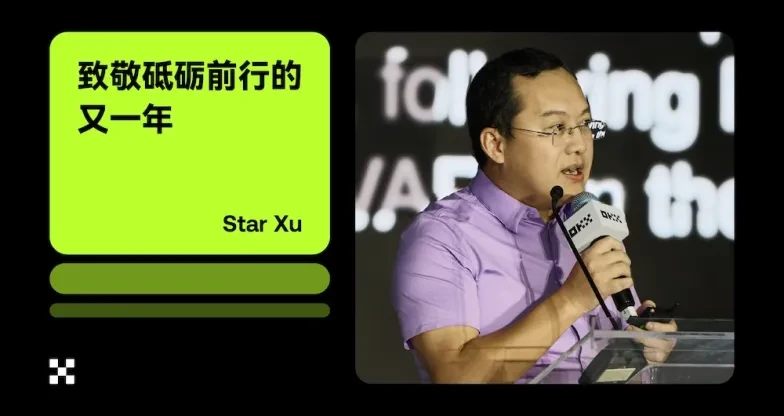
Celebrating Another Year of Building
As CEO of OKX and a builder who stays true to the mission, I take great pride in reflecting on the extraordinary growth and progress OKX has achieved this year. Despite challenges, 2024 was a year marked by focus, innovation, and resilience. We not only expanded and optimized our products but also made significant strides in launching transparent and regulation-compliant localized businesses, while further strengthening our global management team. It is worth noting that after navigating through a challenging period, we reached new heights.
2026年1月29日

2025: Steady Progress Toward Financial Freedom
— A Year-End Letter from OKX Founder & CEO Star to Global Users "Financial freedom" is often misunderstood. It does not mean the absence of rules, but rather having the right to choose even when rules exist — and more importantly, that the system remains reliable and effective when truly put to the test. This has been our unwavering focus throughout 2025. First and foremost, I would like to extend my sincere gratitude to our global customers, partners, and regulators.
2026年1月16日

OKX Officially Launches in Germany and Poland
By Erald Ghoos, CEO of OKX Europe Today is a significant day for OKX — and for cryptocurrency users across Europe. We have officially launched our fully compliant centralized cryptocurrency trading platform in Germany and Poland! For us, this is more than a geographic expansion — it is a commitment to building the future of cryptocurrency the right way: secure, transparent, and tailored to local needs. If you are in Germany
2025年10月21日

Partnership Upgrade! OKX and Standard Chartered Join Forces to Expand Into Europe
On October 15, Erald Ghoos, CEO of OKX Europe, stated that OKX is expanding its strategic partnership with Standard Chartered into the European Economic Area (EEA). Earlier this year, OKX and Standard Chartered first joined forces in the UAE, launching the collateral mirroring initiative — a program that
2025年10月15日