With DeFi in a Slump, Are Algorithmic Stablecoins Still Worth Watching?
Last week, we noticed that the total market capitalization of stablecoins has surpassed $110 billion. However, objectively speaking, the main driver of this growth remains fiat-collateralized stablecoins represented by USDT and USDC, followed by crypto asset-collateralized stablecoins represented by DAI. As for the rising stars—algorithmic stablecoins—while they have also grown, they still appear relatively thin compared to the overall $110 billion market cap. According to statistics from CoinGecko, the current market capitalization of algorithmic stablecoins accounts for less than 1%, with the leading FEI having only a scale of $363 million. Given current market sentiment, algorithmic stablecoins can hardly be considered a market hotspot, especially with DeFi's continued sluggish development for over a month now, algorithmic stablecoins are showing an even more pronounced decline.
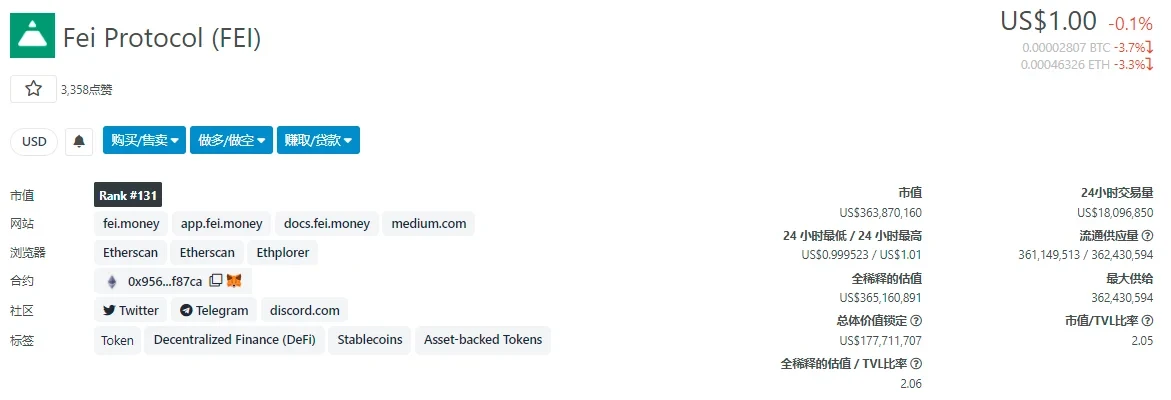
Algorithmic stablecoin FEI market overview, source CoinGecko
However, with this cooling of market heat and dissipation of bubbles, this is clearly a good opportunity for us to re-examine algorithmic stablecoins. Therefore, this article will focus on a brief analysis from several aspects: the connection between algorithmic stablecoins and DeFi, the development history of algorithmic stablecoins, and the future of algorithmic stablecoins. Through this, we hope to have a preliminary discussion with our readers about this great innovation quietly taking place in the cryptocurrency market.
Algorithmic Stablecoins and DeFi
Current algorithmic stablecoins, in some ways, share many similarities with DeFi before 2020. For example, although industry research on DeFi can be traced back to 2014, for a long time before its outbreak in the summer of 2020, it was not favored by market investors, and was even seen merely as a speculative tool. Since the rise of algorithmic stablecoins to the present, doubts have never subsided—views such as "algorithmic stablecoins are unstable" and "algorithmic stablecoins are unsafe" remain topics of ongoing debate within the industry. However, with DeFi's rapid implementation and meteoric rise in multiple important areas such as decentralized lending and decentralized trading, its importance and development potential have gradually been recognized by the market and investors. Today, not only within the cryptocurrency market, many giants and authorities in traditional financial markets are also regarding DeFi as one of the development trends of the future human financial world.
As important infrastructure for DeFi, stablecoins are naturally an unavoidable component. Although there are already numerous collateralized stablecoins using fiat or crypto assets as collateral in DeFi today, from the perspective of usability or nativity, DeFi Lego needs one final piece of the puzzle—this piece is algorithmic stablecoins. Because whether it's fiat-collateralized stablecoins or crypto asset-collateralized stablecoins, they all more or less involve a centralized organization. Only truly decentralized, algorithmic stablecoins with price and supply entirely regulated by the market are the infrastructure that best fits with DeFi.
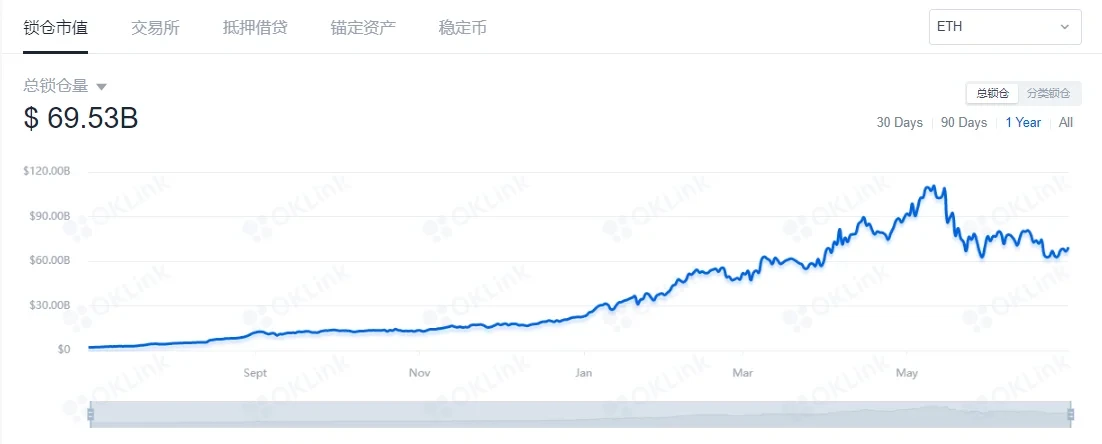
ETH-based DeFi TVL changes, source OKLink
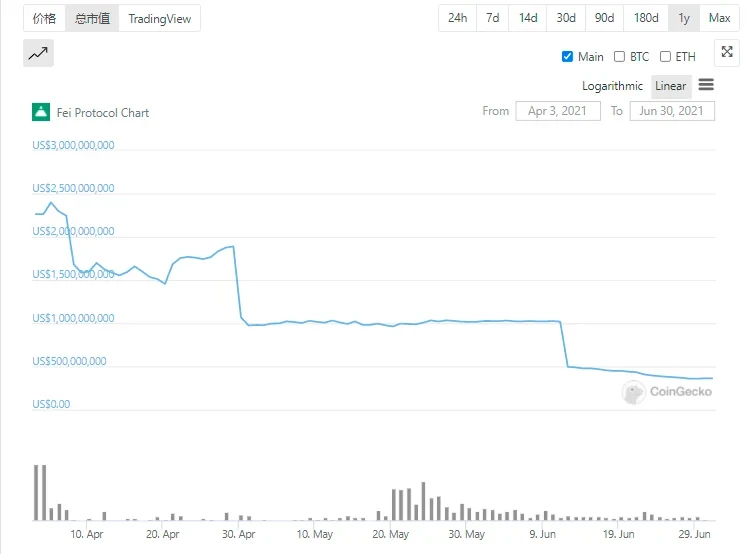
Algorithmic stablecoin FEI total market cap changes, source CoinGecko
At the same time, if we compare the trend of DeFi TVL changes over the past year with the trend of total market cap changes for the leading algorithmic stablecoin FEI, we can also discover some converging patterns. First, looking at DeFi TVL changes: after a year of explosive growth, DeFi TVL reached a historical high in mid-May this year, with on-chain locked asset value exceeding $100 billion, after which it began to enter a downward trend. According to OKLink statistics, current DeFi TVL is approximately $69.5 billion, a reduction of about 30% from the peak period. Then looking at FEI's market cap changes: in early April, FEI's total market cap once approached $2.4 billion, but it was "peak at debut"—this market cap scale did not maintain for many days, hovering between $1.5-2 billion for most of April. After entering May, as DeFi weakened, FEI's market cap also experienced a significant decline, now maintaining around $360 million, a contraction of 85%. In comparison, during the same period, the leading fiat-collateralized stablecoin USDT saw its market cap rise from $40.8 billion to $63.2 billion.
Therefore, it can be said without exaggeration that DeFi is the soil for algorithmic stablecoins—without the fertile soil of DeFi, there would be no market for algorithmic stablecoins. Algorithmic stablecoins are closely tied to DeFi, sharing weal and woe. Only with DeFi's continuous progress can the social practice of algorithmic stablecoins possibly continue.
The Development History of Algorithmic Stablecoins
In fact, in the previous article "The Risks and Opportunities of Algorithmic Stablecoins," we briefly introduced the papers of Professor Ferdinando Ametrano from Politecnico di Milano and cryptocurrency economist Robert Sams, who were the first to research algorithmic stablecoins in academia, as well as the currently mainstream passive and active design mechanisms for algorithmic stablecoins and major algorithmic stablecoin projects such as AMPL, BAC, and Terra. We will not repeat that here. Today, we will focus on understanding recent developments in some important algorithmic stablecoin projects, as a supplement to the previous article.
The algorithmic stablecoin projects to be discussed next are all related to Polygon Network. Polygon Network's predecessor was Matic Network, launched in 2017. Matic Network's main goal was to build an Ethereum scaling architecture, achieving this through the Matic PoS chain and Plasm sidechain scaling solutions. In February 2021, it officially upgraded to Polygon Network.
First is Safe Dollar. On June 28, media reported that the Polygon ecosystem algorithmic stablecoin project Safe Dollar suffered an unknown hacker attack. The stablecoin SDO issued by the project instantly fell to zero from a price of $1.07 on that day. According to analysis by Rugdoc.io, the hacker took away $250,000 worth of USD and USDT from the attack. Subsequently, the Safe Dollar project team issued an announcement requesting investors to stop all SDO-related trading. Currently, SDO trading has been temporarily suspended.
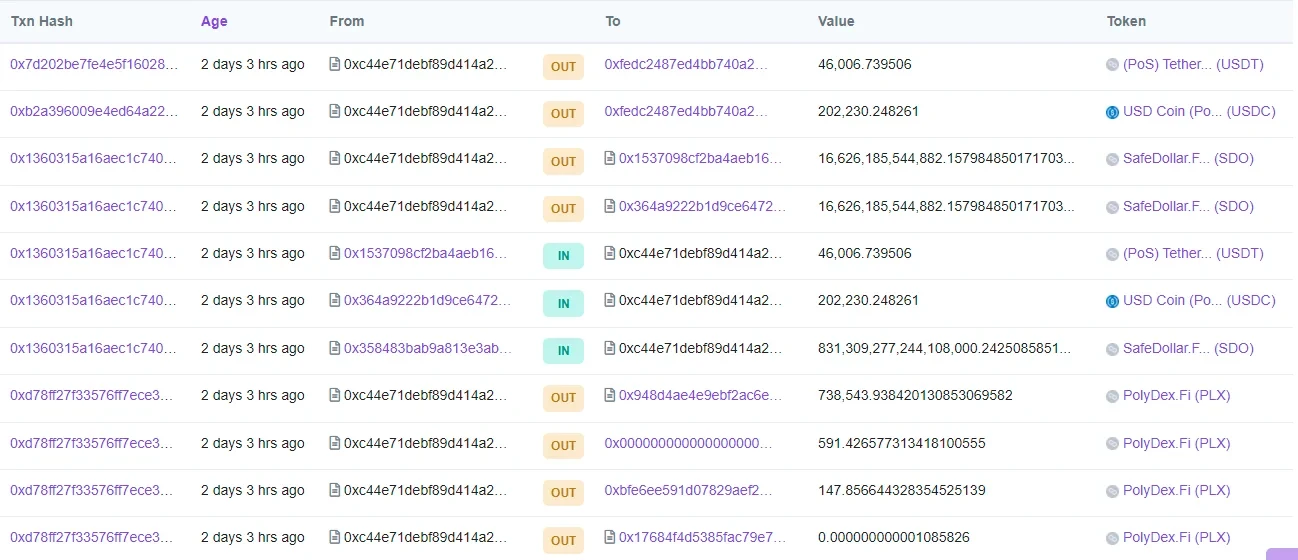
Polygonscan browser screenshot
According to analysis by the Chengdu LianAn security team, in this attack event, the attacker exploited the fact that the actual amount received was less than the amount sent during PLX token transfers, as well as logical defects in the Sdo Reward Pool contract's collateral and reward calculation. By controlling the number of collateral tokens in the collateral pool of the Sdo Reward Pool contract, they manipulated reward calculations to obtain huge amounts of SDO reward tokens, and finally used SDO tokens to swap out all USDC and USDT from the SDO-USDC and SDO-USDT pools. This is a very typical "flash loan" attack method.

The other is the Iron Finance project. Unlike Safe Dollar, the crisis recently encountered by Iron Finance was not due to hacker attacks, but rather a "bloodbath" stampede caused by investor runs. Strictly speaking, Iron Finance is a partially collateralized algorithmic stablecoin project that maintains the stability of its algorithmic stablecoin IRON through collateral stored within a certain period of time. Currently on the Polygon network, there are two types of collateral: USDC and TITAN, meaning minting IRON requires burning TITAN and USDC. TITAN is the governance token of IRON on the Polygon chain, and it was precisely TITAN that experienced the run.
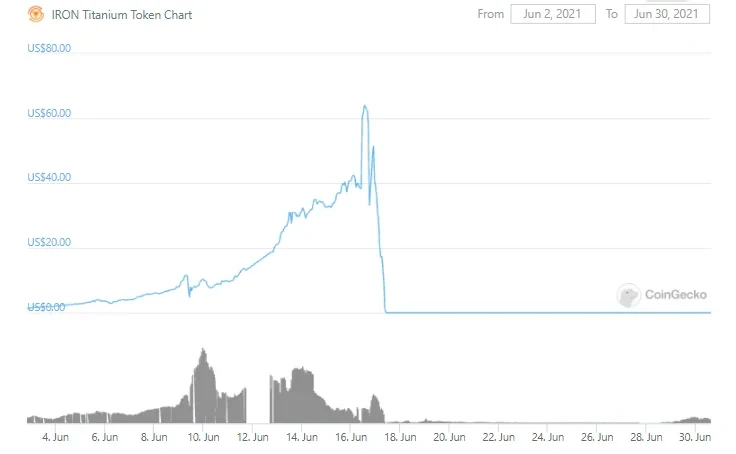
IRON's governance token TITAN plummeted during the run, source CoinGecko
From the chart above, we can see that around 13:00 Beijing time on June 16, the TITAN token price rapidly fell from an intraday high of $65, with the last trade at a price of $0.000000035, approaching zero.
According to the protocol team's post-event review: at the time, they noticed that some large liquidity providers began removing liquidity from IRON/USDC and then started selling their TITAN to IRON. They did not redeem IRON but sold it directly to USDC through the liquidity pool. This caused IRON price to decouple from its dollar value, and this behavior in turn triggered panic among TITAN holders, who began selling TITAN, causing the token price to fall from around $65 to around $30 in approximately 2 hours. TITAN price later recovered to $52, and IRON fully restored its peg. However, the selling did not end. Later the same day, some whales began selling again. Market panic was infinitely amplified, with users redeeming IRON in large quantities and selling their TITAN. Due to the sharp decline in TITAN price, the time-weighted price oracle used to report TITAN price began reporting lagging prices still higher than TITAN's actual market price, creating a negative feedback loop, and the run became uncontrollable.
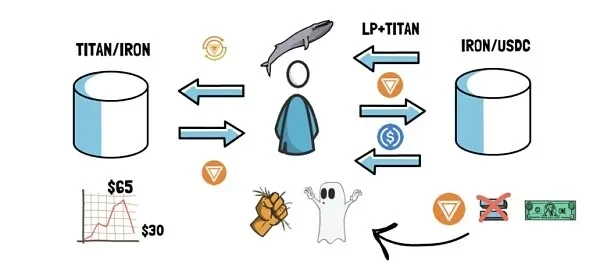
Whales selling TITAN triggered market run, image source internet
Affected by this event, the stablecoin Iron saw a maximum volatility of nearly 50% on that day. Large-scale concentrated redemption operations by investors pushed its price close to $1.5 at one point, far deviating from the expected $1 peg. However, Iron's price soon returned to around the $1 level.
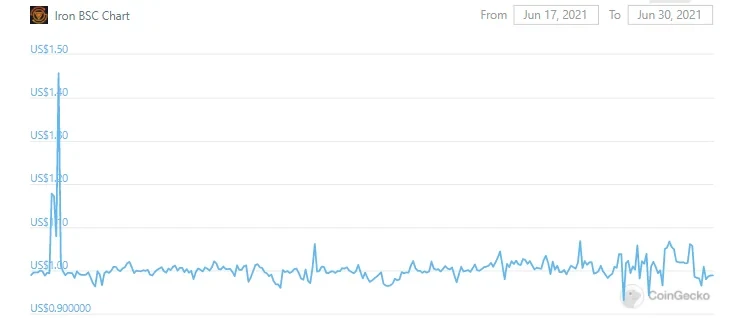
Iron price changes over the past 90 days, source CoinGecko
Regarding post-event compensation measures, on June 28, the Iron Finance team stated that they will continue development on the product side, including Iron Swap (Stableswap DEX), Iron Lend, and Iron stablecoin, and plan to launch Iron Swap on July 5 and the Iron Lend beta on July 19. They will also form an Iron DAO to increase governance participation and encourage community decision-making.
Additionally, Iron Finance will issue a new token to replace the TITAN token. The new token's name has not yet been confirmed, temporarily called "TITANv2," with a fixed total issuance of 1 billion tokens. 70% of the new tokens will be used for liquidity mining rewards, linearly distributed over 3 years; 29% will be used to compensate users affected in the run event, linearly distributed over 3 years; and 1% will be retained in the treasury.
The Future of Algorithmic Stablecoins
On this topic, opinions naturally vary and it is full of imagination. However, based on our introduction above and what everyone understands about the development history of algorithmic stablecoins, we believe the first point to note here is that current industry research on algorithmic stablecoins is still in a very early stage. This means both unlimited opportunities and hidden huge risks. If you do not have sufficient understanding and risk tolerance, please be cautious about participating.
However, this does not mean we are pessimistic about the future development trend of algorithmic stablecoins, because from FEI's evolution, we have already seen the powerful vitality of algorithmic stablecoins. On April 7, the FEI Protocol development team announced the discovery of incentive vulnerabilities and suspended all FEI minting rewards. Many investors were trapped underwater, and FEI's price also fell all the way to around $0.70. However, just one month later, the FEI Protocol development team successfully resolved the known issues, and FEI's price returned above water.
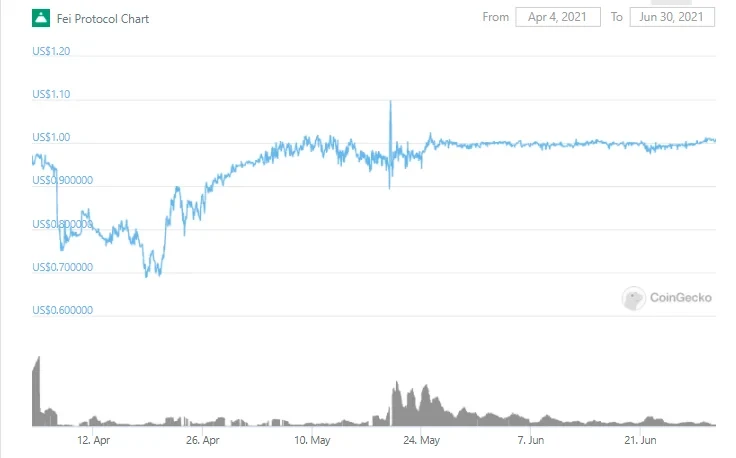
FEI price changes over the past 90 days, source CoinGecko
Therefore, we can see that on the path forward for algorithmic stablecoins, although there are many lessons from failure, the concept of decentralized stablecoins and the approach itself remain very innovative. From a current perspective, DeFi is the natural soil supporting the development of algorithmic stablecoins, but in the future, algorithmic stablecoins should not be limited to DeFi. Algorithmic stablecoins can make DeFi more thoroughly decentralized, while also playing their value on a broader stage. It is foreseeable that before this, algorithmic stablecoins will inevitably go through a difficult and tortuous road, because this is a path that no one in human history has ever walked before. This is a narrow gate, but as long as a beam of light shines through this narrow gate, there will be more brave warriors continuing forward on this path one after another.
Disclaimer
This article may contain product-related content that is not applicable to your region. This article is intended only to provide general information and does not assume responsibility for any factual errors or omissions contained herein. This article represents only the author's personal views and does not represent the views of OKX. This article is not intended to provide any recommendations, including but not limited to: (i) investment advice or investment recommendations; (ii) offers or solicitations to buy, sell, or hold digital assets; or (iii) financial, accounting, legal, or tax advice. Holding digital assets (including stablecoins) involves high risk, may fluctuate significantly, and may even become worthless. You should carefully consider whether trading or holding digital assets is suitable for you based on your financial situation. For questions regarding your specific situation, please consult your legal/tax/investment professional. The information appearing in this article (including market data and statistics, if any) is for general reference only. Although we have taken all reasonable care in preparing these data and charts, we assume no responsibility for any factual errors or omissions expressed herein. © 2025 OKX. This article may be reproduced or distributed in its entirety, or excerpts of 100 words or less from this article may be used, provided that such use is non-commercial. Any reproduction or distribution of the entire article must prominently state: "Copyright © 2025 OKX. Used with permission." Permitted excerpts must cite the article title and include attribution, such as "Article Title, [Author Name (if applicable)], © 2025 OKX". Some content may be generated or assisted by artificial intelligence (AI) tools. Derivative works or other uses of this article are not permitted.
Show More
Recommended Reading
OKX Pay: Opening a New Era of Next-Generation Crypto Payments
The choice of tens of millions of users. Register with OKX and enjoy the ultimate trading experience and diverse wealth management products. A letter from OKX CEO Star: Today, we are officially launching the first version of OKX Pay to our over 100 million global users. As the industry's first payment application to truly achieve non-custodial and compliant integration, OKX Pay will be embedded within the OKX App, currently available in select markets and expected to fully
March 22, 2026

New Chapter: Building Next-Generation Financial Infrastructure Together
The partnership between OKX and Intercontinental Exchange (ICE) is an important moment for OKX and equally significant for the evolution of the entire digital assets market. ICE establishes and operates some of the world's most important financial infrastructure, including the New York Stock Exchange and global derivatives and clearing platforms. This strategic investment by ICE in OKX and joining our board reflects both parties' shared belief—digital assets technology will serve in financial markets
March 10, 2026
Tribute to Another Year of Forging Ahead
As CEO of OKX and also a builder who never forgets the original intention, I look back proudly on the extraordinary growth and progress OKX has achieved this year. Despite many challenges, 2024 was a year filled with focus, innovation, and resilience. We not only expanded and optimized our products, but also made significant progress in launching transparent and compliant localized businesses, while further strengthening our global management team. Notably, after experiencing
January 29, 2026

2025: Steady Progress Toward Financial Freedom Together
— Year-end letter from OKX Founder and CEO Star to Global Users "Financial freedom" is often misunderstood. It does not mean no rules, but rather having the right to choose even when rules exist—and when the system is truly tested, it remains reliable and effective. This is exactly what we have remained focused on throughout 2025. First, I want to extend sincere gratitude to our global clients, partners, and regulatory authorities
January 16, 2026

OKX Officially Launches in Germany and Poland
Author: Erald Ghoos, CEO of OKX Europe Today is a significant moment for OKX—and for cryptocurrency users across Europe. We have officially launched our fully compliant centralized cryptocurrency trading platform in Germany and Poland! For us, this is not just a geographic expansion, but a commitment to building the cryptocurrency future the right way: safely, transparently, and meeting local needs. If you are in Germany
October 21, 2025

Partnership Upgraded! OKX Partners with Standard Chartered to Expand European Market
On October 15, OKX Europe CEO Erald Ghoos stated that OKX is expanding its strategic partnership with Standard Chartered to the European Economic Area (EEA). Earlier this year, OKX first partnered with Standard Chartered in the UAE to launch the collateral mirroring program—this is a
October 15, 2025