Ethereum Layer 2 Thrives, But What About Bitcoin Lightning Network?
Recently, the cryptocurrency market has shown a significant increase in attention towards Layer 2. OKX Academy has also published a series of articles introducing the development status of Ethereum Layer 2: "After DeFi and NFTs, Will Layer 2 Become Ethereum's Next Breakout Point? (Part 1)" and "After DeFi and NFTs, Will Layer 2 Become Ethereum's Next Breakout Point? (Part 2)". Perhaps because the pace of Ethereum network upgrades and community activity have far exceeded Bitcoin in recent years, when we mention Layer 2 today, we primarily think of Layer 2 scaling solutions in the Ethereum ecosystem such as ZK Rollup, Optimistic Rollup, etc. However, the first Layer 2 scaling solution was actually born on the Bitcoin network. It's just that Layer 2 development in the Bitcoin network has been relatively slow, and compared to Ethereum's Layer 2, its scale of development is much smaller, so it hasn't received industry attention.
In the following parts of this article, we'll briefly review the important achievements of Ethereum Layer 2 development so far, but the focus will be on the development history and current status of the Bitcoin Lightning Network.
Brief Review of Ethereum Layer 2 Development Achievements
Similar to the DeFi smart contracts we're familiar with, when measuring the development status of Ethereum Layer 2, we can also get a glimpse of the full picture from the perspective of the total value of locked assets.
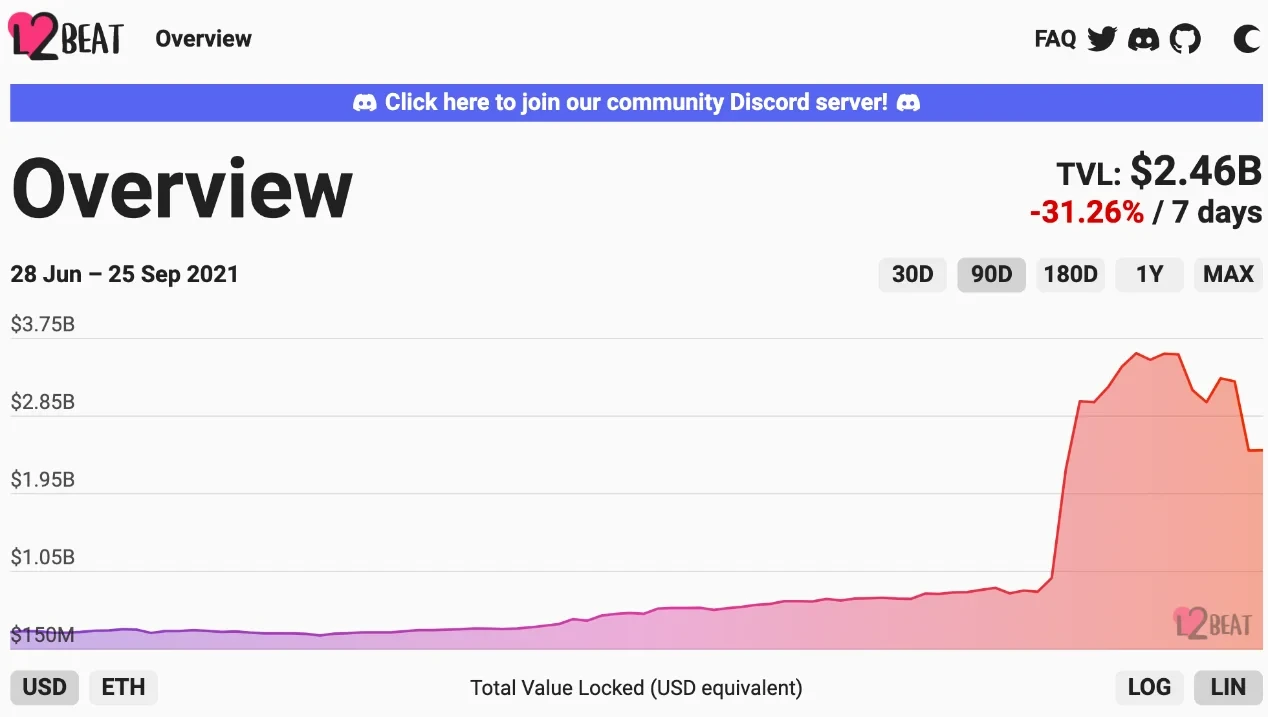
Ethereum Layer 2 total locked asset value changes over the past 90 days, data source L2Beat
From the L2Beat statistics above, it's not difficult to see that Ethereum Layer 2 has made considerable progress recently. As of Hong Kong time September 25, 2021, the total value of assets locked on Ethereum Layer 2 was approximately $2.46 billion, with the amount of locked ETH approaching 840,000. In the 7 days from September 9 to September 16, Layer 2's total locked asset value grew from $821 million to $3.586 billion, an astonishing increase of 337%, with peak ETH lockings successfully surpassing 1 million. Among them, the star Layer 2 project Arbitrum ranked first among all Layer 2 projects with $1.5 billion in total locked value, accounting for 61% of all Ethereum Layer 2 projects.
In the two series articles about Ethereum Layer 2 mentioned in the opening, we mentioned the main reasons for the leapfrog development of Ethereum Layer 2 lockings in recent times—stemming from the official public testing of two major scaling solutions based on Optimistic Rollup in the ecosystem: Optimism and Arbitrum networks. According to official news from the project teams, Ethereum scaling network Arbitrum's mainnet test version Arbitrum One fully launched on September 1 this year. While this is an important milestone, considering that Arbitrum One is still in the testing phase, the official stated they will closely monitor the release and maintain the ability to upgrade quickly, and if necessary, such as detecting abnormal activity or potential security incidents on the network, the system will be paused.
The other important scaling solution Optimism, although based on an Ethereum scaling solution, soft-launched as early as January 16 this year, but for a long time due to various technical debugging, its network was not fully open to the public and didn't support arbitrary deployment of contracts. However, with Uniswap V3 officially deploying to the Optimism mainnet on July 9, the market gradually began to see Optimism's development speed accelerating. On August 20, Optimism planned to open whitelist eligibility to more projects, and any eligible project could submit an application. Projects that obtained whitelist eligibility could deploy on the Optimism network. Although it's been nearly 6 months delayed from Optimism's previous promise to fully open to the public in "March this year", according to the latest news, the Optimism team plans to conduct a major upgrade within the next 3 months, and then decide when to fully open to the public based on the actual situation.
About Bitcoin Lightning Network
In the blockchain industry, there has long been a problem known as the "impossible trinity"—that is, the three goals of security, scalability, and decentralization are difficult to achieve simultaneously under current technical conditions. Starting from actual conditions, as the process of blockchain implementation applications continues to accelerate and deepen, blockchain scalability, or the efficiency problem, has become the most prominent issue facing us. At this point, various scaling solutions have been put on the agenda, and most of these scaling solutions choose to sacrifice some security or decentralization attributes to strengthen blockchain scalability. Overall, blockchain scaling solutions are roughly divided into two categories: Layer 1 scaling and Layer 2 scaling. Layer 1 scaling refers to "modifications" to the underlying blockchain itself, such as block size expansion, Segregated Witness, and sharding technology. A typical case of block size expansion is the "large block" hard fork represented by BCH from the Bitcoin mainnet to operate independently. Layer 2 refers to establishing peripheral or second-layer transaction networks outside the main chain, with the goal of moving most Layer 1 transactions to the second-layer network to reduce mainnet pressure. Among Bitcoin network Layer 2 scaling solutions, the most important is the Lightning Network.
The earliest origin of the Lightning Network can be traced back to Bitcoin itself, because Bitcoin version 0.1 contained a primitive version of code that supported users updating transactions before they were confirmed and packed by miners. If one user's balance increased, another user's balance would correspondingly decrease. Once users completed the transaction, they could only transmit one transaction result to the network and then close their payment channel. For these users, the benefit of this process is—updating transactions through this payment channel method costs less because they don't need to pay miners packing fees, and because they don't need blockchain confirmation, it's also faster.
However, from the above description of the Bitcoin Lightning Network transaction process, we can also discover that the reason it can achieve faster speed and lower fees lies in the philosophy behind this mechanism: "not all transactions need to be on-chain." Obviously, doing so inevitably raises concerns about transaction security. Speaking of this, we need to introduce the Lightning Network's penalty mechanism. This penalty mechanism is implemented by the Lightning Network's RSMC protocol (i.e., Recoverable Sequence Maturity Contract, translated as "sequentially revocable contract"). Simply put, if one party to the transaction publishes an expired transaction balance to the Bitcoin network when closing the channel, upon discovery, the corresponding BTC amount will be confiscated and given directly to the other party. Due to space limitations, we won't introduce too much more about the Lightning Network's penalty mechanism here.
Bitcoin Lightning Network Development Status
Since the Bitcoin Lightning Network is a non-custodial decentralized system where any two users using Bitcoin transactions can establish Lightning Network channels, the number of Lightning Network channels and the amount of Bitcoin transferred to the network can reflect the development scale of the Lightning Network.
First, let's look at changes in the amount of Bitcoin and total value in Lightning Network channels. In the chart below, the yellow curve represents the amount of Bitcoin, and the blue curve represents the corresponding value of Bitcoin.
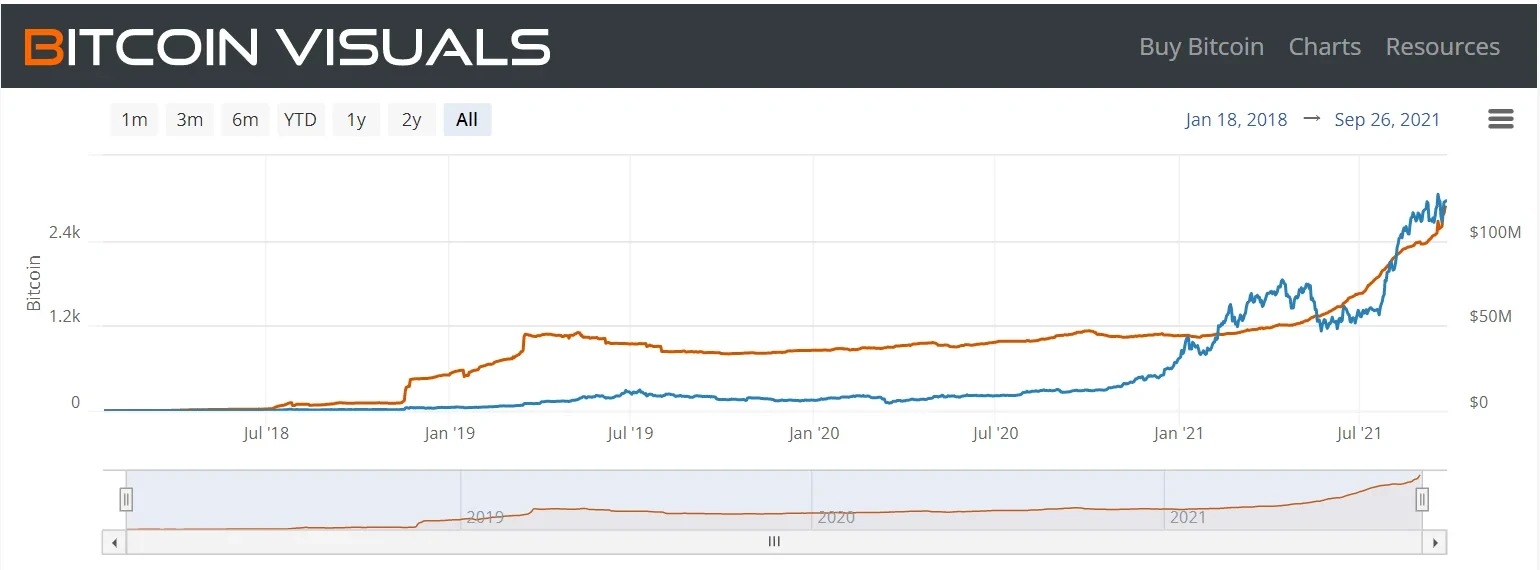
Changes in Bitcoin amount and total value in Lightning Network channels, source bitcoin visuals
According to the above statistics from bitcoin visuals, the amount of Bitcoin in the Lightning Network has been rising in recent months, with a total of 2,893.446 Bitcoin transferred to the second-layer network, calculated at the latest OKX platform quote, with a total value of approximately $123 million.
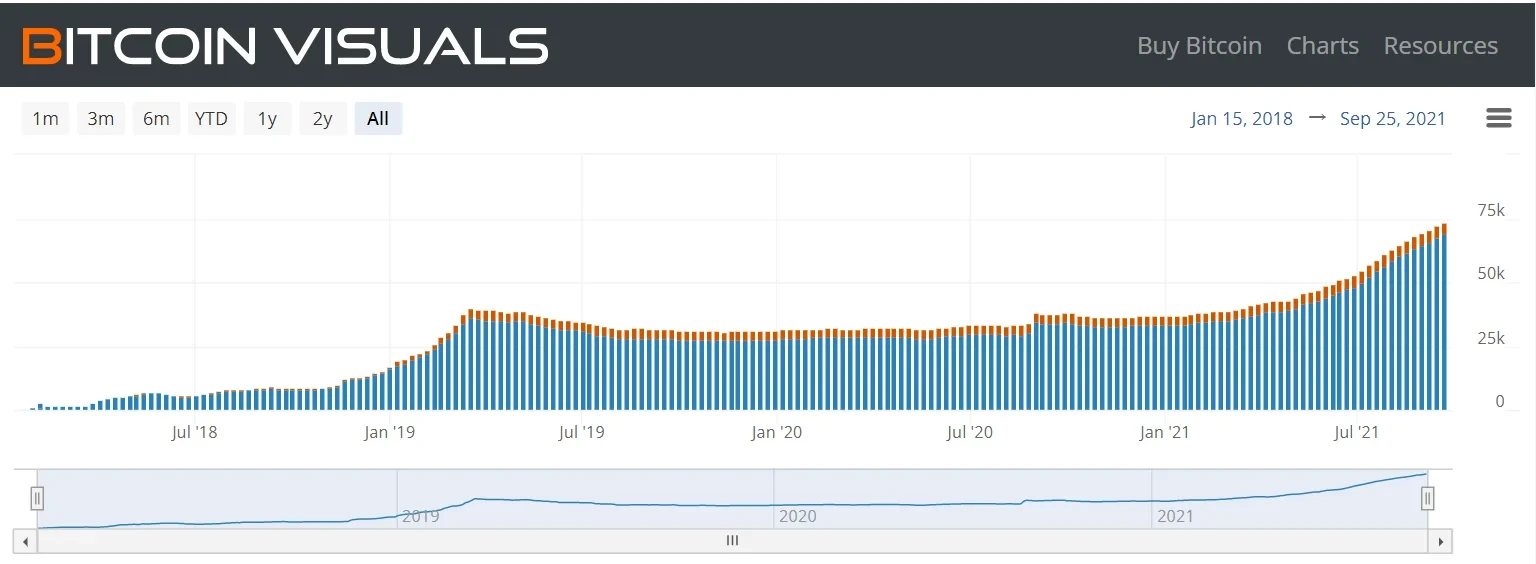
Changes in Lightning Network channel count, source bitcoin visuals
In the chart above, the blue part represents newly established Lightning Network channels, representing the addition of new users. The orange part represents establishing new channels between two nodes that already have other channels, and the increase in quantity represents channels developing towards a mesh structure. From the chart, we can see that the number of Lightning Network channels has been rising recently. In comparison, the growth rate of new users joining the Lightning Network is faster.
However, another reality that needs to be pointed out is that it took 15 months for the amount of Bitcoin in Lightning Network channels to grow from 0 to 1,000, and 28 months from 1,000 to 2,000. Although the speed from 2,000 to 3,000 has shown a significantly accelerated trend, compared to Bitcoin locked on the Ethereum network, both in total amount and growth rate, it lags far behind.
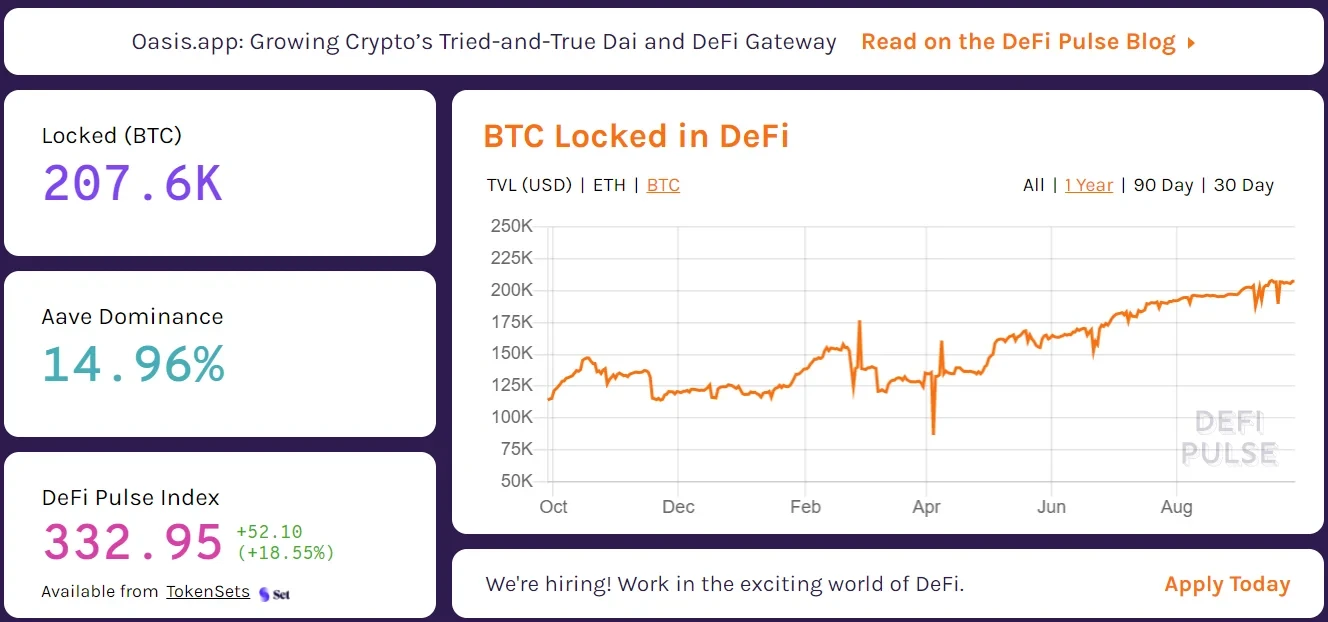
Changes in amount of Bitcoin locked in Ethereum-based DeFi protocols, source defipulse
From the information provided by defipulse, we can see that as of September 27, the amount of Bitcoin locked in Ethereum-based DeFi protocols has exceeded 200,000, approximately 68 times the amount of Bitcoin in the Lightning Network. This also reflects from the side that at the current stage, most Bitcoin holders prefer to participate in DeFi rather than payments. Of course, the reason for this situation is largely due to the different positioning of Bitcoin and Ethereum in the blockchain world, leading to different development paths and rhythms in their second-layer networks. Combining the problems already exposed by the Lightning Network and learning from the development experience of other public chain second-layer networks, if the Lightning Network wants to achieve greater development in the future, it needs to make improvements in multiple aspects such as expanding application scenarios and improving user experience.
Disclaimer
This article may contain content related to products that are not available in your region. This article is intended to provide general information only and does not accept responsibility for any factual errors or omissions herein. This article represents only the author's personal views and does not represent OKX's views. This article is not intended to provide any advice, including but not limited to: (i) investment advice or investment recommendations; (ii) offers or solicitations to buy, sell, or hold digital assets; or (iii) financial, accounting, legal, or tax advice. Holding digital assets (including stablecoins) involves high risk, may fluctuate significantly, and may even become worthless. You should carefully consider whether trading or holding digital assets is suitable for you based on your financial situation. For questions about your specific situation, please consult your legal/tax/investment professional. The information appearing in this article (including market data and statistics, if any) is for general reference only. Although we have taken all reasonable precautions in preparing these data and charts, we accept no responsibility for any factual errors or omissions expressed herein. © 2025 OKX. This article may be reproduced or distributed in its entirety, or excerpts of 100 words or less from this article may be used, provided such use is non-commercial. Any reproduction or distribution of the entire article must also prominently state: "This article © 2025 OKX, used with permission." Permitted excerpts must cite the article name and include attribution, for example "Article Name, [Author Name (if applicable)], © 2025 OKX". Some content may be generated or assisted by artificial intelligence (AI) tools. Derivative works or other uses of this article are not permitted.
Show More
Recommended Reading
OKX Pay: Opening a New Era of Next-Generation Crypto Payments
The choice of tens of millions of users. Register with OKX and enjoy the ultimate trading experience and diverse wealth management products. A letter from OKX CEO Star: Today, we are officially launching the first version of OKX Pay to over 100 million global users. As the industry's first payment application to truly achieve non-custodial and compliant integration, OKX Pay will be embedded in the OKX App, currently available in select markets, with full rollout expected within months
March 22, 2026

New Chapter: Building Next-Generation Financial Infrastructure Together
The partnership between OKX and Intercontinental Exchange (ICE) is an important moment for OKX and equally significant for the evolution of the entire digital assets market. ICE establishes and operates the world's most important financial infrastructure, including the New York Stock Exchange and global derivatives and clearing platforms. This investment by ICE in OKX and joining our board reflects both parties' shared belief—digital assets technology will transform financial markets
March 10, 2026

Tribute to Another Year of Forging Ahead
As OKX's CEO and also a builder who stays true to our original mission, I proudly look back on the remarkable growth and progress OKX has achieved this year. Despite many challenges, 2024 was a year filled with focus, innovation, and resilience. We not only expanded and optimized our products but also made important progress in launching transparent and compliant localized operations, while further strengthening our global management team. Notably, after experiencing
January 29, 2026

2025: Steady Progress Toward Financial Freedom Together
—— Year-end letter from OKX Founder and CEO Star to Global Users "Financial freedom" is often misunderstood. It doesn't mean no rules, but rather having the right to choose while rules exist—and when the system is truly tested, it remains reliable and effective. This is exactly what we focused on throughout 2025. First, I want to extend my sincere gratitude to our global clients, partners, and regulatory authorities
January 16, 2026

OKX Officially Launches in Germany and Poland
Author: Erald Ghoos, CEO of OKX Europe Today is significant for OKX—and for crypto users across Europe. We have officially launched our fully compliant centralized cryptocurrency trading platform in Germany and Poland! For us, this is not just a geographic expansion, but a commitment to building the cryptocurrency future the right way: secure, transparent, and meeting local needs. If you're in Germany
October 21, 2025

Partnership Upgrade! OKX Partners with Standard Chartered to Expand European Market
On October 15, OKX Europe CEO Erald Ghoos stated that OKX is expanding its strategic partnership with Standard Chartered to the European Economic Area (EEA). Earlier this year, OKX first partnered with Standard Chartered in the UAE to launch the collateral mirroring program—this is a
October 15, 2025