Bitcoin's Taproot Upgrade Is Coming: Can It Drive a Price Surge?
On October 11, 2021, Bitcoin continued its upward rally, reaching $57,824.6 by the early hours of October 12, essentially recovering all losses since May. As the crypto market has recently regained momentum, discussions about a "double bull run" have intensified, with many industry insiders holding higher price expectations for Bitcoin.
Against this backdrop, we turn our attention to a significant technical upgrade to the Bitcoin network — the Taproot upgrade — set to launch next month, marking a milestone worth noting in Bitcoin's development history.
On June 12, 2021, according to Taproot.watch data, the Bitcoin Taproot upgrade had been locked in and would activate this November. The Taproot.watch website even produced and released a video to celebrate. This means that when the Bitcoin network reaches the designated block height (709,632) in November, Taproot will be activated, and the Bitcoin Improvement Proposals (BIPs) included in Bitcoin Core 0.21.1 alongside Taproot will automatically take effect.
Since Taproot will be the most significant technical expansion since Bitcoin's Segregated Witness upgrade in 2017, it has garnered tremendous industry attention, particularly viewed by Bitcoin enthusiasts as having extraordinary significance. Taproot is expected to improve Bitcoin's network scalability, privacy, and flexibility, enhance performance and user experience, while minimizing on-chain impact.
So, why does Bitcoin need to upgrade? What exactly is the Taproot upgrade? What potential impact will it have on the Bitcoin network? And can it drive a price surge?
Why Does Bitcoin Need to Upgrade?
As we all know, since Bitcoin's inception, aside from storage and trading, it has virtually no other functions, and its value is more reflected in its role as a store of value and "digital gold." As the infrastructure for value transfer, the Bitcoin network has long suffered from scalability and transaction efficiency issues. With a block size cap of 1MB, the Bitcoin network can only process approximately 7 transactions per second. As a result, Bitcoin network transaction confirmation is very slow, and network congestion has persistently troubled many Bitcoin users.
In recent years, the Bitcoin community has been researching and attempting to find scaling solutions. In August 2017, the Bitcoin community activated the Segregated Witness (SegWit) upgrade in an effort to improve Bitcoin's scalability. SegWit improved scalability by removing digital signature information from each transaction and storing it outside the basic transaction block, thereby reducing block size.
However, this still fell far short of substantially improving Bitcoin's network scalability, and the Bitcoin community has been continuously searching for other solutions, including Bitcoin's Layer 2 scaling solution — the Lightning Network. Although it has greatly improved Bitcoin's transaction congestion issue, Bitcoin's network performance still lags significantly behind mainstream blockchain networks. This makes it difficult for Bitcoin to become a high-transaction-volume digital asset.
Furthermore, and more importantly, Bitcoin's network privacy and security issues urgently need to be addressed. On one hand, the technical-level script settings on Bitcoin publicly disclose contract terms, exposing participant information; on the other hand, in Bitcoin's current ECDSA signatures, identity information can be obtained for free from multi-signature transaction signatures, and participant information can also be tracked through technical means. As Bitcoin's network becomes more widespread and more people participate, these issues have become increasingly prominent.
To improve Bitcoin's privacy and transaction scalability, in January 2018, Bitcoin core contributor Gregory Maxwell, after studying MAST technology, first proposed the concept of Taproot. Later, together with several core developers including Pieter Wuille, Anthony Towns, Johnson Lau, and Jonas Nick, they researched a scheme called Schnorr signatures and incorporated it into Taproot, planned to be showcased in the protocol update.
On May 6, 2019, Bitcoin protocol developer Pieter Wuille posted a soft fork proposal named "Taproot" to the Bitcoin developer mailing list. In January 2020, the Taproot/Schnorr soft fork upgrade proposal was officially released as a Bitcoin Improvement Proposal (BIPs), with associated proposal numbers BIP340-342. As of June this year, it has gained support from the Bitcoin community and miners and is about to be officially activated.
What Is the Taproot Upgrade?
Similar to Ethereum's Ethereum Improvement Proposals (EIPs), Bitcoin also undergoes periodic updates (network soft forks) from time to time, primarily introducing information improvements and new features to Bitcoin through Bitcoin Improvement Proposals (BIPs).
Overall, Taproot is a protocol upgrade designed to enhance Bitcoin's network security, privacy, and flexibility. This upgrade primarily includes three upgrade packages (BIPs): Schnorr signatures (BIP 340), Taproot (BIP 341), and Tapscript (BIP 342). Below, we will introduce the specific contents of each upgrade.
1, Schnorr Signatures
Schnorr signatures were originally a digital signature scheme proposed by German mathematician and cryptographer Claus P. Schnorr in 2008. Later, in 2018, cryptographers Gregory Maxwell and Pieter Wuille from blockchain company Blockstream proposed a Schnorr signature scheme called MuSig. This algorithm signature will serve as an alternative to the elliptic curve digital signature algorithm (ECDSA) that Bitcoin has always used.
Schnorr operates similarly to elliptic curve digital signatures but offers more advantages than ECDSA. The most notable feature is that it allows signature aggregation — multiple parties involved in a transaction can be "aggregated" into a single Schnorr signature. This not only reduces the space occupied by signatures but also makes multi-signature transactions indistinguishable from any other transaction on the network, thereby reducing information exposure and improving privacy and security.
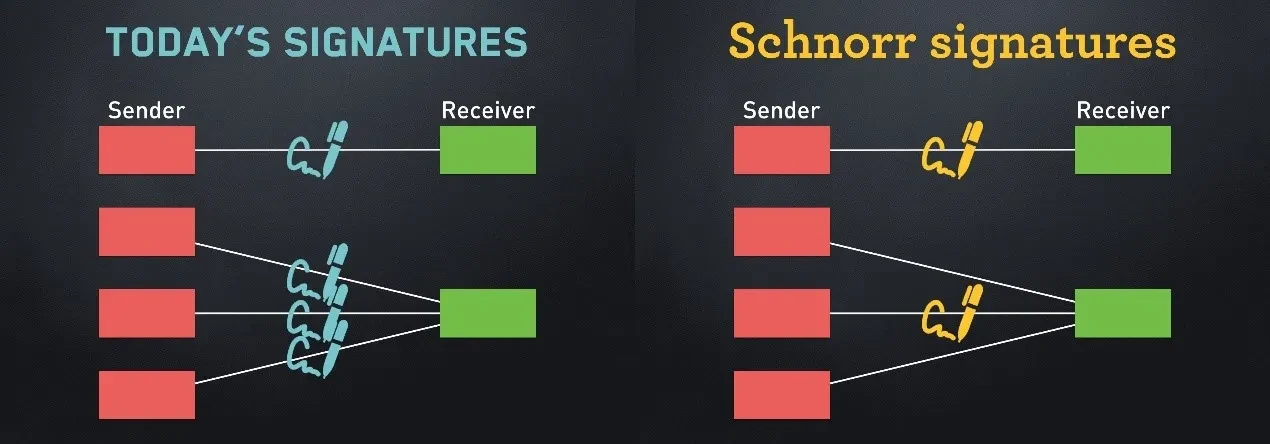
In ECDSA signatures, participant identity information can be traced from multi-signature transaction signatures;
In Schnorr signatures, the original individual signature information cannot be viewed from the resulting single signature.
Additionally, the Schnorr signature algorithm uses the same elliptic curve secp256k1 and hash function SHA256 as the original ECDSA signatures, ensuring it can be compatible with Bitcoin's current public and private key generation mechanism with minimal changes.
2, Taproot
Taproot can be seen as an application of MAST (Merkelized Abstract Syntax Tree). Taproot operates similarly to MAST, dividing transaction spending conditions into Merkle tree hashes. However, compared to Bitcoin's original script logic, a Taproot structure only displays a single adjusted public key generated from a combination of the Merkle root of spending conditions and the original public key.
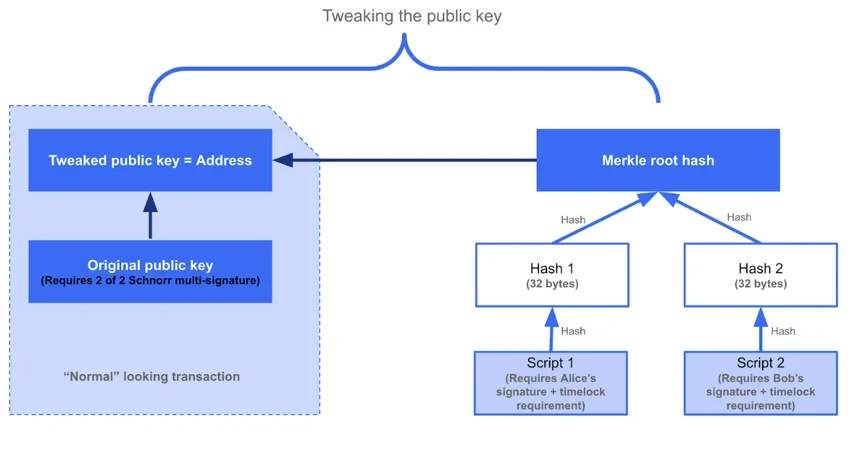
Illustrated explanation of Taproot spending conditions
When combined with Schnorr signature technology, Taproot can hide some scripts in Bitcoin transactions without exposing excessive transaction details. Only during "non-cooperative spending" (Script1 and Script2) does the existence of MAST need to be disclosed, and only the executed portion of the script needs to be revealed. Through this solution, not only can Bitcoin transaction size be reduced, but all intermediate data can be hidden, protecting user privacy.
3, Tapscript
BIP 342 is a supplementary upgrade to Schnorr and Taproot. It adds and updates several opcodes, which are part of the machine language instructions that specify operations to be executed. BIP 342 supplements the improvements needed for Bitcoin's script structure as proposed in BIP 341 (Taproot), allows batch verification of Schnorr signatures, and adds new opcodes to enhance Bitcoin's smart contract functionality.
Impact of the Taproot Upgrade
If we are to discuss the significant impacts the Taproot upgrade will bring to Bitcoin, they primarily manifest in two areas: privacy and scalability.
As we summarized earlier, the main technical concepts of the Taproot upgrade are Schnorr signatures and MAST. These two upgrades can directly improve Bitcoin's current network security, privacy, and scalability.
First, let's look at Schnorr signatures. As we mentioned earlier, aggregated signatures can make multi-signature transactions appear as normal single-signature transactions on-chain. This makes multi-signature transactions difficult to distinguish, and individual transactions are hard to trace — this can improve privacy for multi-signature users. According to data charts from p2sh.info, the usage rate of multi-signatures is currently growing rapidly. For institutions and ordinary users with multi-signature needs, the Taproot upgrade will bring significant optimization to the user experience.
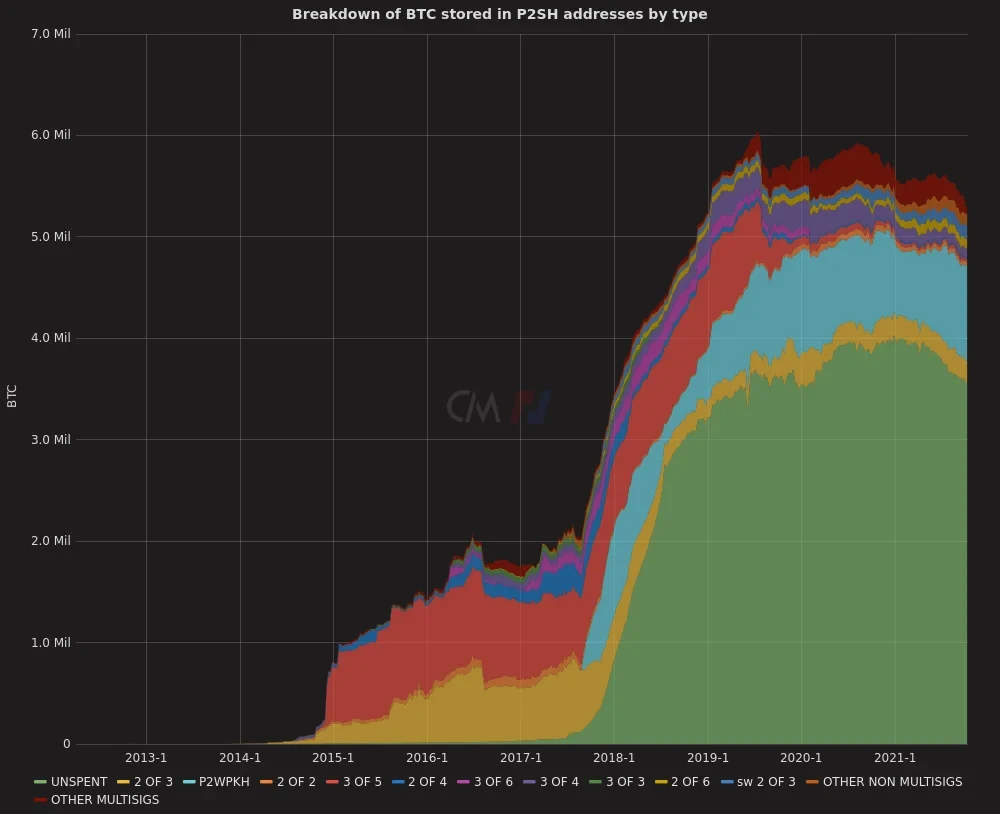
Bitcoin stored by P2SH address type
Additionally, Schnorr signatures reduce the original signature bytes (Schnorr signatures are 64 bytes, while ECDSA signatures are 71-73 bytes), thereby saving transaction space. The Blockstream team, in a paper titled "Simple Schnorr Multi-Signatures with Applications to Bitcoin" published in 2018, mentioned that using MuSig can save enormous space for the Bitcoin network, potentially leading to a latent increase in Bitcoin network capacity. (This only includes savings from using multi-signatures, not potential savings from key aggregation.)
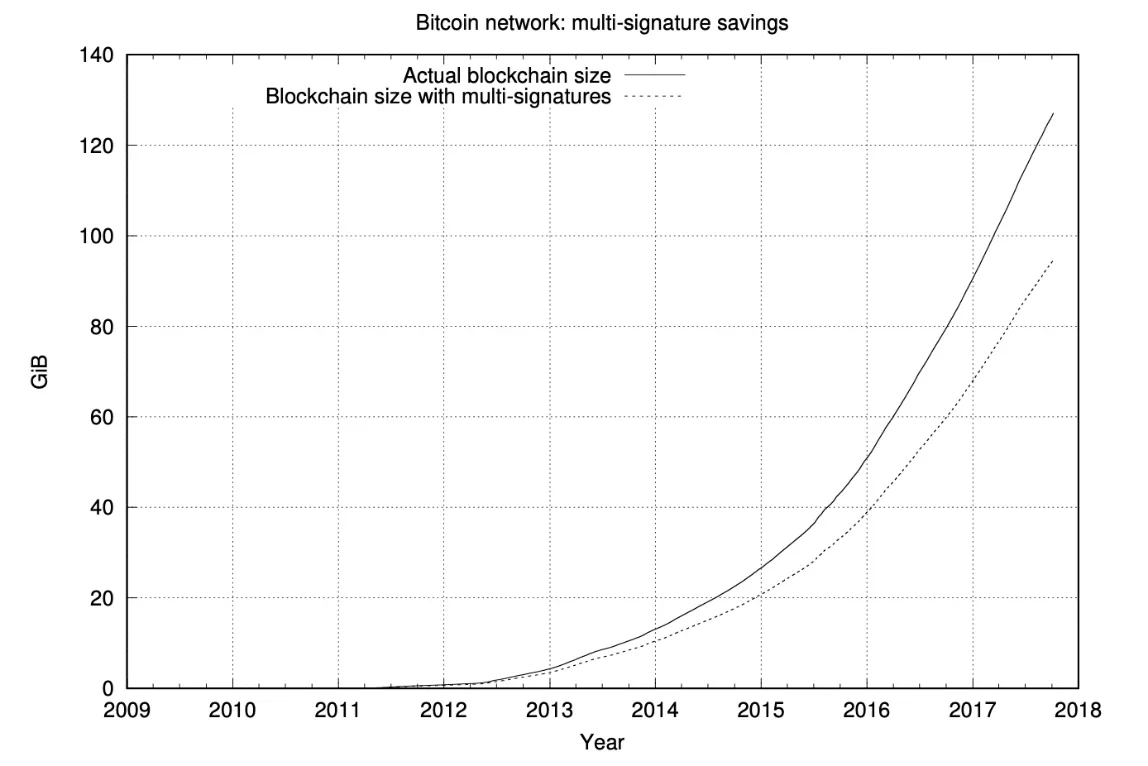
Bitcoin blockchain size with and without multi-signatures
Source: Simple Schnorr Multi-Signatures with Applications to Bitcoin
Beyond space savings, Schnorr signatures can also be verified in batches. Compared to verifying ECDSA one by one, this greatly saves verification time, thereby improving transaction processing efficiency. This could mean that in the future, the entire Bitcoin network's transactions can become faster and cheaper.
As for MAST, with MAST being introduced into the Bitcoin blockchain protocol, Taproot reduces the originally attached lengthy scripts in transactions by changing its spending condition structure, thereby reducing the data footprint of each Bitcoin transaction. Through combination with Schnorr signature technology, transaction space is further saved, while also being able to reduce security and privacy threats for most current Bitcoin network transactions to a certain extent. Ultimately, whether these potential impacts at the network level can be reflected in market performance and whether they can help Bitcoin's price reach new historical highs is something to look forward to.
In summary, although compared to the声势浩大的声势 of Ethereum's previous upgrades, Bitcoin's upgrades may seem less impressive, it is undeniable that the arrival of Taproot and its impact are worth the attention of the Bitcoin community and Bitcoin enthusiasts. The blockchain scalability issue has long been a major concern, and for both Bitcoin and Ethereum, this issue has yet to be fundamentally resolved. While Bitcoin's Lightning Network has made progress, its overall effectiveness compared to Ethereum Layer 2 has been limited. Currently, Ethereum is also on the path of transitioning to ETH 2.0. This Taproot upgrade comes at just the right time for Bitcoin, expected to enhance its privacy attributes and payment attributes, and consolidate and elevate Bitcoin's competitiveness among digital assets.
References: 1 Schnorr and Taproot:https://medium.com/@listedreserve/schnorr-and-taproot-cc4fa1edc828
2 Maxwell, Gregory, Andrew Poelstra, Yannick Seurin, and Pieter Wuille, 2018, "Simple Schnorr Multi-Signatures with Applications to Bitcoin".https://eprint.iacr.org/2018/068.pdf
Disclaimer
This article may contain product content not applicable to your region. This article is only intended to provide general information and does not accept responsibility for any factual errors or omissions herein. This article represents only the author's personal views and does not represent OKX's views. This article is not intended to provide any advice, including but not limited to: (i) investment advice or investment recommendations; (ii) offers or solicitations to buy, sell, or hold digital assets; or (iii) financial, accounting, legal, or tax advice. Holdings of digital assets (including stablecoins) involve high risk and may fluctuate significantly, or even become worthless. You should carefully consider whether trading or holding digital assets is suitable for you based on your financial situation. For questions about your specific circumstances, please consult your legal/tax/investment professionals. The information contained in this article (including market data and statistical information, if any) is for general reference purposes only. Although we have taken all reasonable precautions in preparing this data and these charts, we do not accept any responsibility for any factual errors or omissions expressed herein. © 2025 OKX. This article may be reproduced or distributed in its entirety, and excerpts of 100 words or less may be used, provided that such use is non-commercial. Any reproduction or distribution of the full article must prominently state: "This article is copyrighted © 2025 OKX, used with permission." Permitted excerpts must cite the article name and include the source, for example: "Article name, [author name (if applicable)], © 2025 OKX". Some content may be generated or assisted by artificial intelligence (AI) tools. Derivative works and other uses of this article are not permitted.
Show More
Recommended Reading
OKX Pay: Ushering in the Next Generation of Crypto Payments
The choice of tens of millions of users. Register with OKX and enjoy an exceptional trading experience and diverse wealth management products. A letter from OKX CEO Star: Today, we officially launch the first version of OKX Pay for over a hundred million global users. As the industry's first payment application to truly achieve a fusion of non-custodial and compliant services, OKX Pay will be embedded within the OKX App and is currently available in select markets, with full rollout expected within a few months.
2026年3月22日

A New Chapter: Building the Next Generation of Financial Infrastructure Together
The partnership between OKX and the Intercontinental Exchange (ICE) marks a significant moment for OKX and holds equally profound meaning for the evolution of the entire digital assets market. ICE establishes and operates the world's most important financial infrastructure, including the New York Stock Exchange and global derivatives and clearing platforms. This investment by ICE Select in OKX and joining our board of directors reflects our shared belief that digital assets technology will transform financial markets.
2026年3月10日
Honoring Another Year of Relentless Progress
As OKX's CEO and a builder who stays true to original aspirations, I take great pride in reflecting on the extraordinary growth and progress OKX has achieved this year. Despite numerous challenges, 2024 was a year filled with focus, innovation, and resilience. We not only expanded and optimized our products but also made significant strides in launching transparent and regulation-compliant localized businesses, while further strengthening our global management team. It is worth noting that after experiencing.
2026年1月29日

2025: Steady Progress Toward Financial Freedom
—— A Year-End Letter to Global Users from Star, OKX Founder & CEO "Financial freedom" is often misunderstood. It doesn't mean the absence of rules, but rather having the freedom to choose even when rules exist — and more importantly, that the system remains reliable and effective when truly put to the test. This has been our unwavering focus throughout 2025. First and foremost, I want to express my sincere gratitude to our global customers, partners, and regulators.
2026年1月16日

OKX Officially Launches in Germany and Poland
By Erald Ghoos, CEO of OKX Europe. Today is a momentous day for OKX — and for crypto users across Europe. We have officially launched our fully compliant centralized cryptocurrency exchange in Germany and Poland! For us, this is more than just a geographic expansion; it is a commitment to building the future of cryptocurrency the right way: secure, transparent, and tailored to local needs. If you are in Germany.
2025年10月21日

Partnership Upgrade! OKX and Standard Chartered Expand into the European Market
On October 15, Erald Ghoos, CEO of OKX Europe, stated that OKX is expanding its strategic partnership with Standard Chartered to the European Economic Area (EEA). Earlier this year, OKX first partnered with Standard Chartered in the UAE, launching the Collateral Mirroring initiative — a.
2025年10月15日