"Three Levels, Two Perspectives" on the GameFi Sector About to Explode
Recently, the majority of financing events in the blockchain industry have occurred in the GameFi field. Taking the period from October 30 to November 5 as an example, there were 27 investment and financing events in the crypto market, 14 of which occurred in the GameFi field. Blockchain game studio Mythical Games even secured $150 million in Series C funding. This shows that from a financing perspective, GameFi is currently receiving "special attention" from capital.
Before DeFi and NFTs exploded, large-scale financing frequently occurred, and shortly thereafter, DeFi Summer and NFT Autumn arrived. Now the same script is playing out in the GameFi field.
In addition, with the arrival of numerous high-quality GameFi projects and high-performance GameFi platforms from 2021 Q4 to 2022 Q1, this field will inevitably present a different landscape. These projects include Star Atlas, Illuvium, etc., while platform projects include Immutable X, Gala, GameFi, etc. So will GameFi Winter arrive as scheduled? What is the current state of GameFi on different public chains? And from what perspective should we observe the GameFi sector?
1**, GameFi Status on Different Public Chains**
According to data from 659 GameFi projects counted by playtoearn, these projects are distributed across Ethereum, Solana, BSC,Flow, Tron, Cardano, WAX and other public chains, covering turn-based games, sandbox games, card games, RPG games, farm social games, and competitive games. Projects involved include Axie Infinity, My DeFi Pet, Illuvium, Sandbox, Decentraland, Gods Unchained, DeFina, Big Time, Mist, Ember Sword, Guild of Guardians, Townstar, My Neighbor Alice, Zed Run, Gold Fever, and more.
According to the comprehensive ranking method given by playtoearn, among the top 50 projects, 10 projects run on Ethereum, 20 projects run on BSC, 1 project runs on Flow, 4 projects run on Polygon, 1 project runs on Tron, 1 project runs on Avalanche, 3 projects run on Enjin, 3 projects run on Solana, 1 project runs on Cardano, 5 projects run on Wax, and 1 project runs on Xaya.
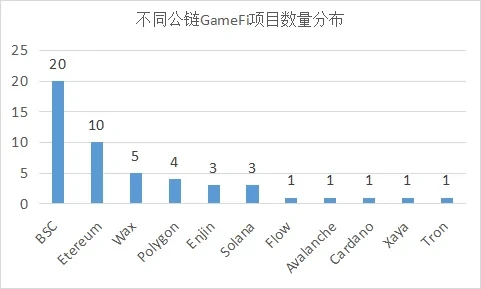
It should be noted that although Axie Infinity runs on the Ronin sidechain, its settlement layer is on Ethereum, so it is still considered an Ethereum project. In addition, some GameFi projects run across multiple chains and are counted separately in corresponding public chains. For example, Mimir-Quiz simultaneously selects Ethereum, Polygon, and Xaya, so Mimir-Quiz will be counted 3 times.
The above statistics show that GameFi is significantly different from NFT avatars and generative art projects that mostly cluster on Ethereum. GameFi has higher performance requirements and is more sensitive to transaction fees. This is an important reason why different public chains are "blooming everywhere" in the GameFi field.
Of course, if looking by trading volume and number of players, the true infrastructure king of the GameFi ecosystem is still Ethereum, because the NFT trading volume of the entire crypto ecosystem is $9.3 billion, with Axie alone accounting for over $3 billion in trading volume.
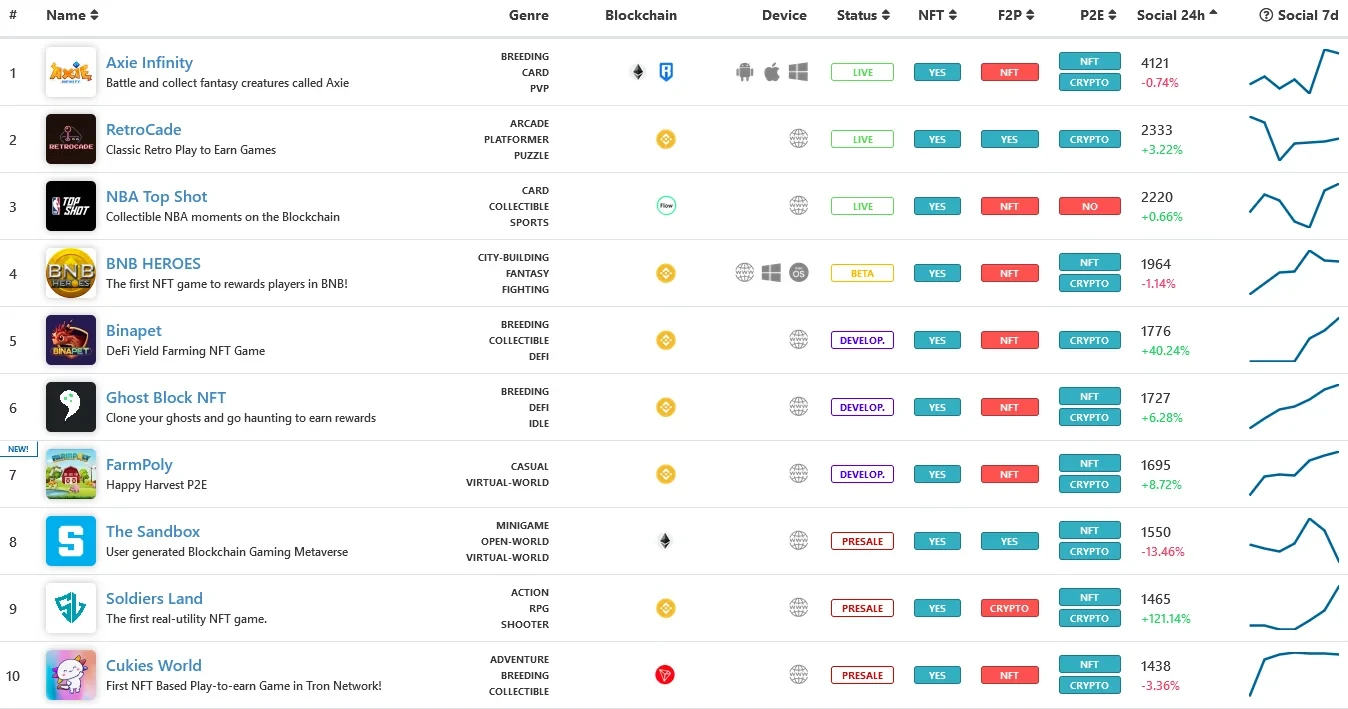
Data source: playtoearn
In addition, Star Atlas, Aurory, and Project Seed from the Solana ecosystem, and Defina Finance from the BSC ecosystem are worth attention.
Star Atlas combines various advanced technologies such as blockchain, real-time graphics, multiplayer video games, and decentralized finance, dedicated to building the next-generation gaming metaverse. Star Atlas runs on the Solana public chain, conducts trading through Serum, and utilizes Nanite's Unreal Engine 5, with strong technical development support.
Defina Finance is a game project based on the blockchain NFT GameFi concept. The game's story background is set in a virtual universe parallel to reality and time. Heroes from human epics are reincarnated into the virtual universe in the form of NFT cards. Players in the game use obtained hero characters to engage in PVE or PVP mode battles, level up, play-to-earn, NFT card trading, and many other functions, gaining rewards in an immersive gaming experience. The Defina team is distributed across Asia, Europe, and Silicon Valley. The game team comes from traditional game giants with rich game development experience and game economic model design.
How should we observe the GameFi ecosystem? From what perspectives should we evaluate GameFi projects?
2**, Viewing the GameFi Sector About to Explode from Three Levels and Two Perspectives**
Whether GameFi can break into the mainstream ultimately depends on three points: GameFi must balance returns, playability, and smoothness.
First, at the returns level, it can be understood in three ways. The first is gamification of DeFi, where users transform assets into NFT equipment and complete tasks through liquidity mining and other methods to obtain rewards. Representative projects include ARCx, DEGO, etc. The second is GameFi = NFT + DeFi, which refers to introducing NFT collateral into DeFi. Representative projects include Aavegotchi, Meme, Whale. The third is projects that truly possess both gaming and financial attributes. Representative projects include Axie Infinity, Star Atlas, Illuvium, Chainmonster, Big Time, etc. Regardless of the game type, participants ultimately ask about the return on investment.
Axie Infinity has remained popular to this day due to its excellent economic model and good playability, becoming the key to opening the door to the GameFi world. The latest data from DappRadar shows that Axie Infinity trading volume has exceeded $3 billion, ranking first in NFT collectibles. This data was only $2 billion on September 13, with trading volume growing by $1 billion in less than two months.
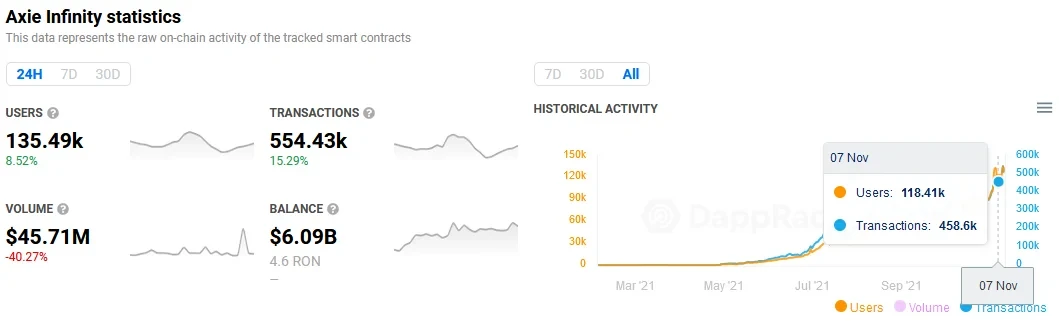
Axie Infinity user data, data source: dappradar.com
Second, at the game playability level. Current GameFi games still have a considerable distance compared to traditional game production quality. The most important reasons are the game's logic design and aesthetics. However, with the entry of well-known chain game companies like Gods Unchained (Immutable X developer) and traditional game giants like UBISOFT, game playability and aesthetics issues may be resolved.
Finally, at the game smoothness level. Traditional games have TPS in the thousands, which GameFi cannot match. However, judging from Axie Infinity's performance after Ronin went live, with sidechains, Ethereum Layer 2, Solana, BSC, and other high-performance Layer 1 support, performance issues will eventually be solved.
Whether GameFi can break into the mainstream is related to the above three characteristics, so GameFi development directions need to be observed from two perspectives: the GameFi project perspective and the platform perspective.
In terms of projects. Different GameFi games can be categorized as turn-based games represented by AXIE, My DeFi Pet, Illuvium; sandbox games represented by Sandbox, Decentraland; card games represented by Gods Unchained, DeFina; RPG games represented by Big Time, Mist, Ember Sword, Guild of Guardians; farm social games represented by Townstar, My Neighbor Alice; and competitive games represented by Zed Run, Gold Fever.
Some of these games have reached or even surpassed current traditional AAA (high development cost, long development cycle, high resource consumption) games in production quality. Projects like Star Atlas, Cradles, Illuvium, etc. are worth anticipating.
In terms of platforms. GameFi platforms are essentially high-performance infrastructure supporting GameFi operations. They can be dedicated platforms like Ronin, Immutable X, Gala, GameFi, or general platforms like Solana, BSC, Ethereum. Undoubtedly, the heavy responsibility of supporting GameFi development will fall on these high-performance Layer 2 and Layer 1 solutions and sidechains.
Take the Ethereum sidechain Ronin as an example. It is currently developing toward a GameFi platform direction with rapid progress.
Ronin performs well in asset staking volume. Dune Analytics data on November 7 shows that Ethereum bridge current TVL reaches $24.79 billion. The top 5 bridges by staking volume are Ronin Bridge ($8.247 billion), Polygon Bridges ($5.346 billion), Avalanche Bridge ($4.971 billion), Arbitrum Bridges ($2.842 billion), and Fantom Anyswap Bridge ($2.077 billion).
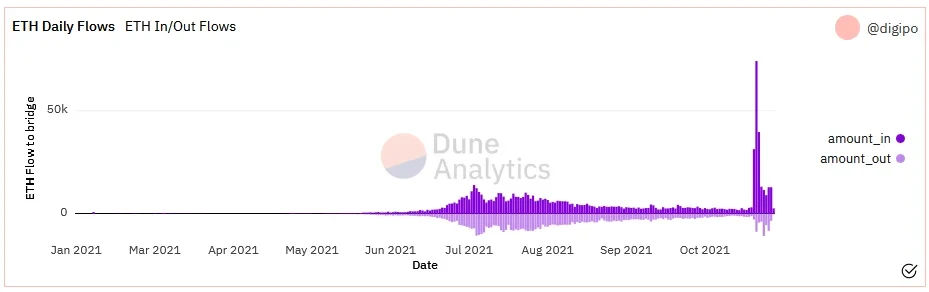
Ronin Bridge ETH staking data, data source: dune.xyz
In addition, the decentralized exchange Katana has launched on the Ronin sidechain, introducing the token RON for paying gas fees, while providing on-chain custody services for Axie Infinity and future game products. Currently, "Katana" allows AXS, SLP, USDC, and WETH to be traded.
In terms of token issuance, according to official news, the Ronin sidechain is also launching the token RON and opening liquidity mining on the decentralized exchange Katana. Currently, it supports AXS/ETH and SLP/ETH trading pairs. Users can create accounts through Ronin wallet, bridge assets to the Ronin network through Ronin Bridge or from exchanges like Binance for liquidity mining.
Finally, taking Immutable X as another example, this project is an Ethereum Layer 2 project tailored specifically for GameFi. The well-known Illuvium game will launch on this platform. The project's predecessor team is the well-known chain game company Gods Unchained. This legendary production team, Fuel Games, created a revenue record of 400 ETH in 5 days during the 2019 bear market. In the game's public beta phase, they created over 4 million NFT game cards and in the same year created a "sky-high price" NFT game card—a Mythic worth $62,000. Strong investment backgrounds from Coinbase, FTX, Animoca, and others also make it a star team born with a silver spoon.
In summary, GameFi is currently in a situation where both game projects and game platforms are flourishing. Whether it can evolve into a true prototype of the metaverse in the future remains to be seen.
Disclaimer
This article may contain content about products that are not available in your region. This article is intended only to provide general information and does not take responsibility for any factual errors or omissions herein. This article represents only the author's personal views and does not represent the views of OKX. This article is not intended to provide any of the following advice, including but not limited to: (i) investment advice or investment recommendations; (ii) offers or solicitations to buy, sell or hold digital assets; or (iii) financial, accounting, legal or tax advice. Holding digital assets (including stablecoins) involves high risk, may fluctuate significantly, and may even become worthless. You should carefully consider whether trading or holding digital assets is suitable for you based on your financial situation. For questions about your specific situation, please consult your legal/tax/investment professional. The information appearing in this article (including market data and statistics, if any) is for general reference only. While we have taken all reasonable precautions in preparing these data and charts, we accept no responsibility for any factual errors or omissions expressed herein. © 2025 OKX. This article may be copied or distributed in full, or excerpts of 100 words or less from this article may be used, provided that such use is non-commercial. Any copying or distribution of the entire article must also prominently state: "Copyright © 2025 OKX, used with permission." Permitted excerpts must cite the article name and include attribution, for example "Article Name, [Author Name (if applicable)], © 2025 OKX". Some content may be generated or assisted by artificial intelligence (AI) tools. Derivative works or other uses of this article are not permitted.
Show More
Recommended Reading

2025 KOLs' Most Used OKX Products Ranking Roundup
In the cryptocurrency industry, professional players' choices are always direct and pure. In 2025, KOLs used a full year of capital investment and time accumulation to cast the most genuine votes for industry tools and ecosystem development. We focused on four core questions—"What was the biggest achievement this year?", "Given the achievements, what OKX products did you use most and like best in 2025?", "Why do you like it?", and "This
January 5, 2026

2026 Investment Outlook: Assets On-Chain, Intelligence and Privacy | OKX Annual Record
Three major trends for the future of crypto: asset transformation, entity transformation, and rule transformation. As we approach 2026, bidding farewell to the past four years of infrastructure-focused "road building," the crypto industry is welcoming a profound paradigm shift. OKX Ventures defines this as the opening of the "Kinetic Finance" era, where the core is no longer how fast the network is, but the flow and earnings of on-chain assets
December 31, 2025

Voting with Data: Insights into 2025 Popular Trading Products | OKX Annual Record
Looking only at market conditions, it's difficult to explain the return differences between exchange users in 2025. What truly determines returns also depends on account-level operational methods, not just market volatility itself. The OKX annual statement shows that mainstream coins remain the core of fund turnover and return generation, supporting trading and strategy execution; emerging coins are more used to amplify volatility and provide phased opportunities, but are not stable, long-term sources of returns. What truly continuously contributes returns is
December 30, 2025
Fusaka in Practice: What Ethereum's Latest Upgrade Means for L2, Nodes, and Users
The Ethereum mainnet has completed the Fusaka fork. At the protocol level, this upgrade mainly includes four components. Full text Q&A with the core views and frontline experience of three guests: Ahmad (@smartprogrammer) – Nethermind execution client / Ethereum core developer Manu (@manunalepa) – Prysm / Of
December 16, 2025
OKX Research | Why Did RWA Become a Key Narrative in 2025?
RWA (Real World Assets) is becoming a global capital "favorite." Simply put, RWA means taking valuable, ownership-bearing things from the real world—such as houses, bonds, stocks and other traditional financial assets, or even art, private lending, carbon credits and other assets that are not easily directly traded—onto the blockchain, turning them into tradable, programmable crypto assets. In this way, not
November 20, 2025
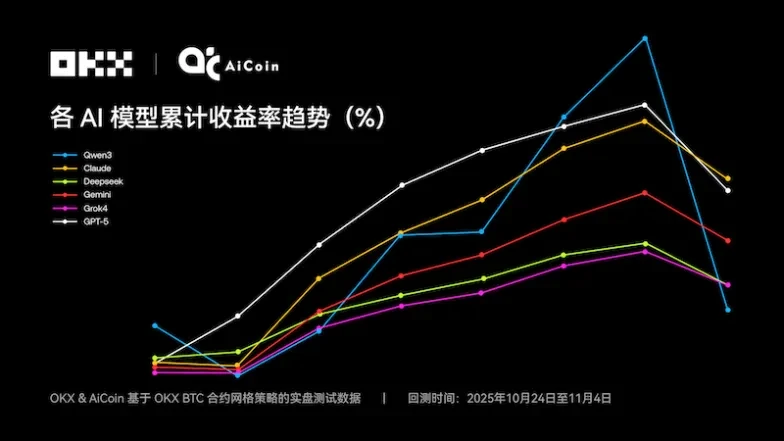
Claude Takes Championship, 6 Major AI Grid Strategy Showdown Truths | OKX & Ai Coin Live Evaluation
Short-term trading champion Qwen3—is it also a king in grid strategies? The first season of the "AI Trading Live Arena" launched by NOF1 finally concluded at 6 AM on November 4, 2025, whetting the appetite of the crypto, tech, and finance circles. But the outcome of this "AI IQ public test" was somewhat unexpected. The total principal of $60,000 across six models was only $4.3 at conclusion
November 6, 2025