OKX Research | Ethereum Genesis Block Tenth Anniversary: The World Computer Myth in Progress

Author: @c_luyishisi (Shisi Jun)
In 2011, a 17-year-old Russian-Canadian teenager initially wrote articles for a website called "Bitcoin Weekly," earning 5 Bitcoin per article. "This was my first real job, with a wage of about $1.30 per hour," he later recalled.
Those 5 Bitcoin are worth $600,000 today—a hundred-thousand-fold increase that witnessed the crazy growth of the entire cryptocurrency era.
Even more shocking is that Ethereum, created by this teenager Vitalik Buterin, has developed no slower than Bitcoin itself: today, with a market capitalization of over $400 billion, it processes over $5 trillion in annual trading volume.
Please follow this article to look back at the decade since the launch of the Ethereum genesis block. This was also a decade of fire and growth for the blockchain industry. See how it evolved from the imagination of a writing youth earning $1.30 per hour to infrastructure that changed the operating logic of the entire digital world. In this process, what changes in the technical foundation brought about the migration of the superstructure.
Prehistory—Bitcoin is Where the Dream Began
From Bitcoin Inspiration to Ethereum Creator
In 2013, the soaring price of Bitcoin ignited Vitalik's infinite imagination, but also made him see Bitcoin's limitations. As a contributor to "Bitcoin Magazine," he delved deeper into the Bitcoin community but discovered that if this revolutionary financial system were to be switched to the new goal of programmability, making the blockchain system expand beyond the dimension of pure financial products would be extremely difficult.
Moreover, in the blockchain world of that time, smart contracts were just an extremely vague concept—no definition, no samples, and no direction.
In the initial vision, contracts only supported some fixed-function scripts—such as simple multi-signatures, time locks, or two-party contracts like Mastercoin, where participants A and B both deposit funds, then returns are distributed according to a preset formula. This scripting language was completely not Turing-complete and could only describe terms of a two-party relationship, far from being a true "world computer," let alone intelligent.
Vitalik advocated to Bitcoin core developers that the Bitcoin platform should have a more complete programming language for people to develop programs. However, the conservatism and minimalism philosophy of the Bitcoin community fundamentally conflicted with Vitalik's vision of a more general, more open blockchain. Moreover, various expansion solutions in the market at the time were patching things up, and no one dared to propose a completely redesigned solution.
So he made a decision that, in retrospect, indeed changed the world: develop a new platform.
Moving forward, the decision was made, but looking back, it was not clear. Although it was a new platform, exactly how to design and implement it was a major problem.
A turning point in late 2013 occurred during Vitalik's long walk in San Francisco. He suddenly realized that contracts could be completely generalized—if it was a smart contract, it itself could be a fully mature account, with the ability to hold, send and receive assets, and even could maintain permanent storage of some state. So why not go further, breaking the scripts that describe fixed relationships, to design a virtual machine capable of executing arbitrary computation?
The initial Ethereum design even adopted a register-based architecture (rather than the later stack-based architecture), with a novel fee mechanism built in: with each calculation step executed, the contract's balance would decrease a bit; if the contract's funds were exhausted, execution would stop. This was the prototype of the early "contract pays" model, which later evolved into the familiar "sender pays" and Gas system.
In late 2013, Vitalik wrote the Ethereum whitepaper, whose core was to define the goal—to create a universal decentralized computing platform where anyone could deploy and run decentralized applications, not fixed-function scripts, but a truly Turing-complete computing environment.
However, from the ideal vision to implementable technical specifications, there was still a huge gap to cross. At this time, Gavin Wood's joining became a key turning point. In 2014, Gavin Wood wrote the famous "Ethereum Yellow Paper," the formal technical specification of how the Ethereum virtual machine operates.
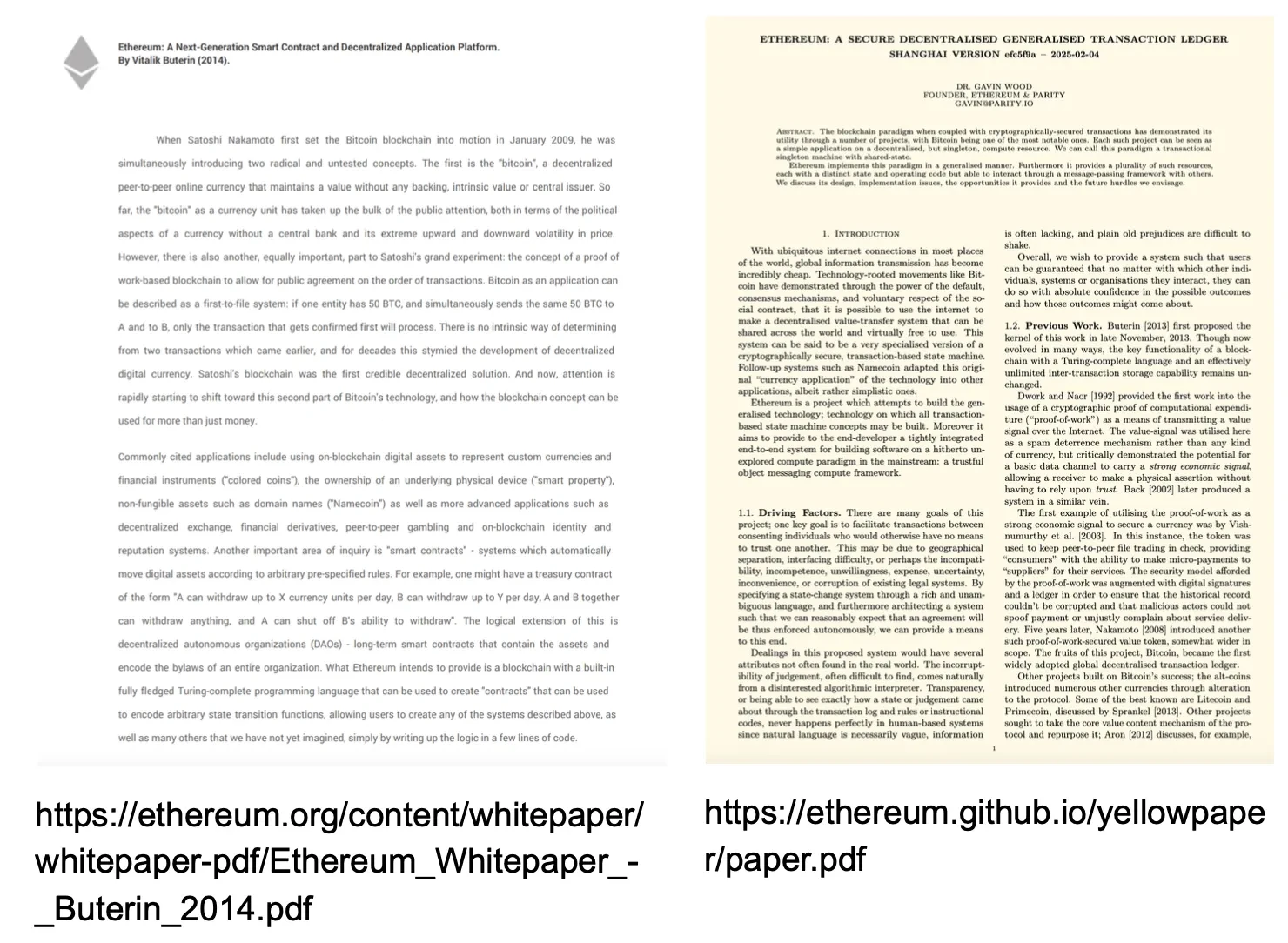
The whitepaper depicted the "Why" and the "What," while the yellow paper precisely defined the "How." The combination of these two documents brought Ethereum from concept to reality.
Key Technical Decisions and Evolution in Berlin
From 2014 to 2015, Berlin became the spiritual holy land of Ethereum. Vitalik was often active in Berlin's Bitcoin Kiez area like a "pilgrim," and Room 77 became a gathering place for the early crypto community. In the office at Waldemarstraße 37A, just 1.5 kilometers from Room 77, Ethereum's core team worked day and night writing code.
During this stage, the Ethereum protocol underwent countless technical iterations: from register-based architecture to stack-based architecture, from "contract pays" model to "sender pays" Gas system, from asynchronous internal transaction calls to synchronous execution. Many decisions had far-reaching impacts.
For example, the EVM (Ethereum Virtual Machine) unified 256-bit integer model was initially designed to adapt to the common bit width of hash functions and encryption algorithms, and to avoid overflow risks in design. Although it seemed overly conservative at the time, it naturally adapted to the complex high-precision mathematical operations in DeFi (such as fixed-point, multiplication/division rounding), and also avoided precision problems in JS/float-like languages.
Also, if a transaction runs out of Gas, the entire execution rolls back rather than partially completing. This design eliminates the entire attack surface of "partial execution attacks," becoming the cornerstone of all smart contract security later. Moreover, this design has greater economic drive—on one hand, technically, the Gas required for execution cannot be predicted before contract execution; on the other hand, because of the loss from failure, senders have more incentive to control costs and behavior, avoiding blind transaction submission.
Everyone's technical creativity brought many unexpected surprises. For example, Vitalik initially envisioned an asynchronous contract call model, but Gavin Wood naturally adopted synchronous calls during implementation based on engineering and semantic consistency considerations. This seemingly unintentional turn laid the key technical foundation for later DeFi composability—making it possible for one contract calling another to synchronously return execution results, creating the predictability and atomicity of "money Legos."
It should be noted that Ethereum DeFi applications have high interdependence, not a single ecosystem. For example, lending protocols use DAI/USDC as collateral, stablecoin minting modules call Chainlink as oracles, and many market-making protocols provide leverage based on Aave and Compound. In this series of linkages, synchronous calls played a crucial role, but it has both advantages and disadvantages. Also because of synchronous calls, performance expansion is more difficult. In subsequent Ethereum, it was necessary to select more complex expansion ideas (see the L2 section below).
In addition, the well-known PoW mining algorithm also underwent multiple rounds of iteration, from the Dagger algorithm proposed by Vitalik, to Dagger-Hashimoto in collaboration with Thaddeus Dryja, to Ethash emphasizing ASIC resistance. During these processes, directions such as adaptive difficulty, memory-hard structures, and random access circuits were also constantly attempted.
Of course, many difficulties had unexpected surprises, but naturally became subsequent technical debt. In 2025, when Vitalik proposed replacing EVM with RISC-V, he admitted: "Ethereum history has often failed to maintain simplicity (sometimes due to my own decisions), which led to our excessive development expenditure, various security risks, often in pursuit of benefits that have proven to be illusory."
A Historic Moment: July 30, 2015
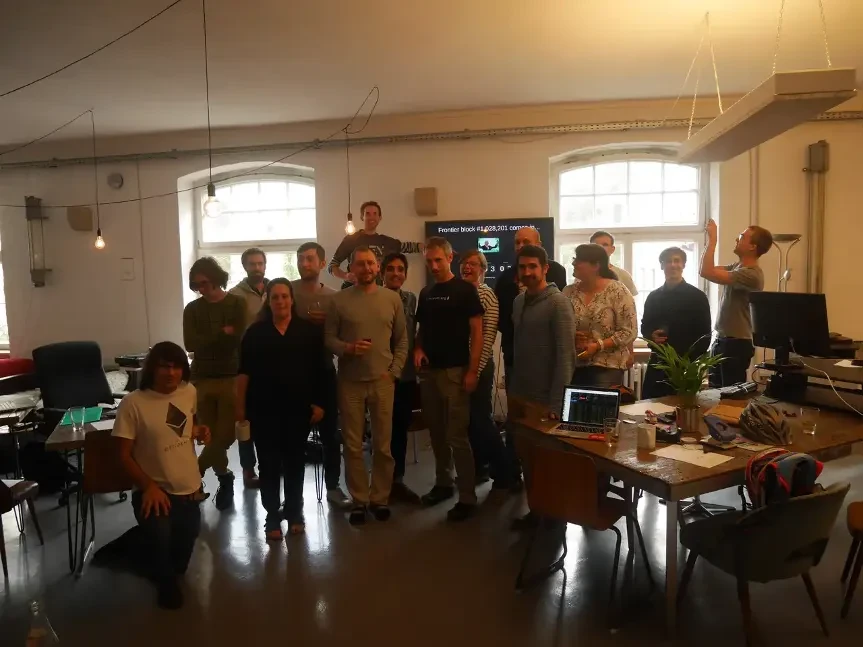
On July 30, 2015, Vitalik still remembers the scene in the Berlin office that day: "Many developers gathered together, and we were all watching the block count on the Ethereum testnet reach 1,028,201, because this marked the automatic launch of the Ethereum mainnet. I still remember us all sitting there waiting, and then it finally reached this number, and Ethereum blocks began generating about half a minute later."
At that moment, Ethereum had fewer than 100 developers in total, and the entire ecosystem was just a technical experiment. The first decentralized Twitter application "Ether Tweet" was crude like "the Wright brothers' plane," and every tweet required paying high on-chain fees. Smart contracts were just toys for a few geeks, and DeFi, NFT, and Layer 2 only existed in whitepaper imaginations.
Now searching for that address on Google Maps, you can still see it marked with "Ethereum Network Launch (30/07/2015)," as well as a group photo of early Ethereum core members—one of the most important photos in crypto history.
On July 30, 2025, when Ethereum celebrated its tenth anniversary, as of the first half of 2025:
-
In the first quarter of 2025, a record 6.1 million wallets participated in on-chain governance voting.
-
Ethereum adds approximately 350,000 new wallets per week, thanks to users joining through Layer 2s.
-
As of March 2025, the number of active Ethereum wallets reached 127 million, a year-on-year increase of 22%.
-
It leads far ahead in the stablecoin market, with a market capitalization of $82.1 billion, accounting for 60.0% of the total.
-
The TVL (Total Value Locked) of various DeFi protocols exceeds $45 billion.
-
Uniswap's daily trading volume exceeds $2.1 billion, and lending platforms like Aave and Compound collectively hold over $13 billion in locked assets.
-
In the past 12 months, Ethereum has recorded over 28,400 GitHub commits in core repositories.
-
The number of active developers contributing to Ethereum-related projects currently exceeds 5,200.
There are many more data points I won't list here. What I want to express by listing these is that this "edge experiment" that once had fewer than 100 developers has grown into the largest-scale development platform and ecosystem in the Web3 world.
In ten years, from a few transactions per day to processing $5 trillion in value annually, from high fees of several dollars per transaction to less than one cent on Layer2, from PoW mining consuming electricity like a small country to PoS mechanism consuming less electricity than a building, from crude Ether Tweet demo applications to a mature DeFi ecosystem with 80% priced in ETH—behind every number lies the unremitting efforts of countless developers and the trust choices of users. When the US SEC approved 9 ETH spot ETFs with first-day trading volume exceeding $1 billion, this former "crypto edge experiment" has become one of the world's top large-scale assets, having an increasingly profound impact at the core of the mainstream financial system.
However, the journey from the young man in the Berlin office to the creator of a new generation of global financial infrastructure was not smooth. Over the decade, Ethereum experienced the growing pains of technical upgrades, the tests of hacker attacks, the baptism of market cycles, and countless critical choices about survival. Every crisis was a reshaping, every upgrade was a metamorphosis, every controversy was a growth. It was these turbulent key nodes that shaped the Ethereum we see today.
Let us return to those decisive moments and re-examine how this legend was forged in the storm.
Ten-Year Journey—Key Nodes and Evolution Logic
2015-2017: From Genesis to Hard Fork and ICO Mania
The summer day when the Ethereum mainnet launched marked the beginning of the smart contract era.
Early Ethereum was like an experimental technical showcase platform, not a truly usable product. Most of the applications running on the network were simple demos—such as Ether Tweet (a decentralized Twitter clone), Wei Fund (crowdfunding platform), and various crude voting contracts.
Unstable Gas prices made every interaction feel like a gamble, sometimes unable to get on-chain for an hour. Even more headache-inducing for developers was that the Solidity language was extremely immature, and the compiler often had strange bugs (such as variable shadowing, stack overflow, jump logic errors). Smart contract security often relied on developers' personal experience.
Despite technical immaturity, the Ethereum community showed unprecedented idealistic enthusiasm. Weekly developer meetings were always packed with programmers from around the world, discussing how to use smart contracts to reconstruct the entire world—from autonomous organizations to prediction markets, from identity systems to supply chain management. Today, it has indeed blossomed everywhere. And this optimistic sentiment was mixed with an almost intense belief: code is law, mathematics is truth, decentralization is freedom.
With this sentiment, in May 2016, a project called "The DAO" launched on Ethereum, hailed as "the largest crowdfunding experiment in human history." In just 28 days, it raised $150 million worth of ETH (accounting for 14%–15% of the entire network), becoming the largest venture capital fund in the world at the time.
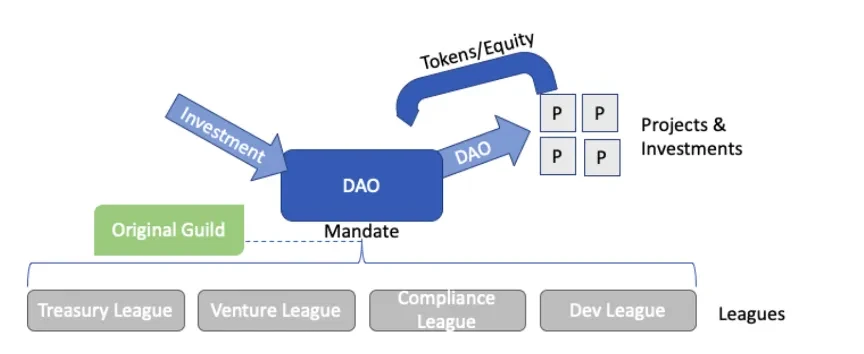
Image Source | The DAO Whitepaper:https://github.com/the-dao/whitepaper
At this time, a huge crisis quietly arrived. On June 17, a hacker used a reentrancy attack vulnerability in The DAO smart contract to successfully steal 3.6 million ETH (about 5% of Ethereum's total supply at the time).
The core of this attack lay in a typical reentrancy vulnerability in the design of The DAO smart contract's splitDAO function—a classic attack pattern later written into smart contract security textbooks.
When users called the split DAO function, the contract would execute the following steps: first send rewards to users through the withdrawRewardFor function, then update user balances. The problem was that the withdrawRewardFor function ultimately used the call.value() method, using the underlying call() to send ETH to the receiver (using such a low-level transfer mechanism was also a problem point). Then, when the receiver (attacker)'s contract received ETH, its fallback function was triggered, immediately calling the splitDAO function again. This formed reentry (reentrancy attack). Since the first call had not completed (balance had not yet been updated), the attacker could repeatedly extract funds based on the same balance.
The attacker deployed two identical malicious contracts and achieved 29 repeated extractions through recursive calls. Each extraction was calculated based on the same original balance, ultimately successfully transferring tens of millions of dollars in ETH to their child DAO under their control. Ironically, this vulnerability was discovered and warned about by multiple developers before the attack occurred, but under the belief of "code is law," no one thought the contract operation should be suspended.
This plunged the entire Ethereum community into an unprecedented philosophical crisis. On one side were technical purists who insisted that blockchain immutability was sacred and inviolable, believing that although the attack was morally wrong, it was technically "legal" because the attacker was just following the contract's code logic. On the other side were pragmatists who believed that protecting investor interests and maintaining the Ethereum ecosystem were more important than abstract principles.
Correspondingly, Gavin Wood (co-founder, former CTO, Yellow Paper author) responded in a public interview: "Blockchain should be immutable, and on-chain code should also be the code that truly controls logic." But he also admitted: "If I saw someone being robbed on the street, I would be willing to step forward to stop the robbery and return the stolen goods."
Vitalik Buterin later wrote in his blog: "I sleptless all night, repeatedly thinking about what true decentralization is. If we can arbitrarily modify history, then what's the difference between Ethereum and traditional databases? But if we watch helplessly as attackers take away community funds, how do we face those who trust us?"
After intense community debate, Vitalik ultimately chose a hard fork (this is exactly the split story between Ethereum and Ethereum Classic). He later reflected: "We learned a cruel truth—absolute decentralization is a beautiful ideal, but in the real world, we must find a balance between pure principles and human needs." This lesson was reflected in every subsequent network upgrade: technical decisions must serve the overall interests of the community, not abstract ideology.
If the DAO incident was Ethereum's coming of age, then the 2017 ICO craze was its adolescence. In this year, over 50,000 ERC-20 token contracts were deployed to the Ethereum network, raising over $4 billion in funds, and blockchain began rewriting the rules of the traditional venture capital game.
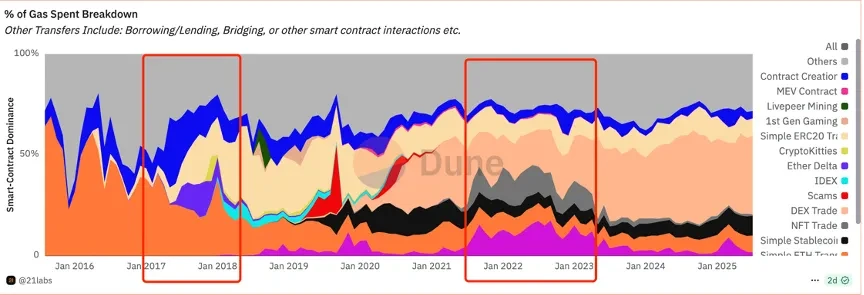
Image Source | dune:https://dune.com/queries/2391035/3922140
Looking at historical data, using Gas consumption analysis, we can see that in 2017-2018, a large number of contracts were generated (yellow part in the left red box in the figure), and ERC20 transfers also became popular. The types of on-chain assets transformed from native coins (ETH) to diverse ecosystem applications.
There was also a digital cat game called CryptoKitties that occupied 15% of the network's transaction capacity in just a few days, causing Gas fees to soar from a few cents on ordinary days to tens of dollars, and transaction confirmation times to extend from a few minutes to several hours. It was precisely this foreshadowing that allowed the second NFT craze (gray part in the right red box in the figure) to remain calm after the London upgrade completed in 2021.
The ecosystems that exploded in each cycle continuously raised the demand for on-chain space, making people deeply realize how far the processing capacity of 15 transactions per second was from the grand vision of a "world computer."
2018-2022: Forging the Future in Silence—From Technical Accumulation to Ecosystem Explosion
Continuous Technical Revolution (2018-2022)
When the 2018 ICO bubble burst and speculators left the market one after another, the number of Ethereum developers did not decrease but increased. It was in this quiet year forgotten by the outside world that Ethereum completed a series of key technical upgrades, laying a solid foundation for the later ecosystem explosion.
With almost one upgrade per year, the Byzantium fork, Constantinople fork, and Istanbul fork came out one after another. Many changes were actually not very noticeable to users, bringing more underlying changes. It can be seen that by reducing block rewards from 5 ETH to 3 ETH, Ethereum began to find a balance between inflation and security; these upgrades introduced various underlying support capabilities for Layer 2 expansion, including laying the groundwork for zero-knowledge proof technologies like zk-SNARKs. The introduction of the CREATE2 opcode gave multi-chain contracts the ability to create deterministic addresses.
And what really alleviated the user's perception of transaction congestion was EIP-1559 in the 2021 London upgrade. This proposal, through the dual mechanism of base fee and priority fee, solved the defects of the traditional "blind auction" mechanism. Before EIP-1559, users had to guess appropriate Gas prices—bidding too low meant transactions might not be packed for a long time, bidding too high wasted a lot of funds. Worse, during network congestion, users would often panic and dramatically increase bids, causing fees to spiral upward in a "price war."
But it's not that congestion disappeared after EIP-1559, because EIP-1559 solved the "price discovery" problem, not the "capacity" problem.
The actual throughput of the Ethereum mainnet did not significantly increase as a result—it still can only process about 15 transactions per second. It only made prices more predictable through the characteristic of base fees automatically rising during congestion, until some users give up using due to excessive prices. This is like building a better toll station, making queuing more orderly and fees more transparent, but the number of highway lanes has not increased.
Real "road widening" still needs to rely on Layer 2 solutions—this is also why rollup technologies like Arbitrum and Optimism, as well as blobs from EIP-4844, have become the core of Ethereum's expansion roadmap.
During this period, there was also a fundamental technical shift: the evolution of Ethereum's consensus mechanism. Initially, Ethereum inherited Bitcoin's PoW model, but the PoS solution explored since 2015, after repeated demonstrations of various technical routes like Casper FFG and Casper CBC, finally determined the direction with the successful launch of the Beacon Chain.
On December 1, 2020, 520,000 ETH completed staking in just one month. By 2022, The Merge successfully launched, reducing Ethereum's energy consumption by 99.95%, not only meeting the environmental requirements of regulators and investment institutions, but also laying the foundation for future sharding expansion and further optimization of the Beacon Chain, truly achieving the transition from "mining is security" to "staking is governance."
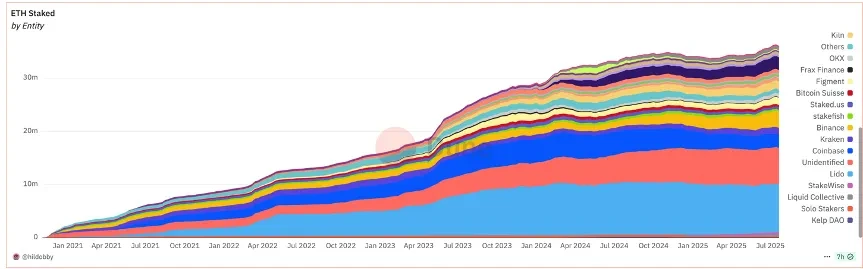
Image Source | Ethereum Staking Data:https://dune.com/hildobby/eth2-staking
Today, Ethereum has over 1.1 million validators, with 36 million ETH locked for staking, approximately 29.17% of total supply. Such scale of staking participation provides unprecedented economic security for Ethereum—an attacker wanting to launch a 51% attack would cost millions of ETH, an extremely high price. Moreover, staking participants are diverse, making the overall security more difficult to shake.
But consensus is not meant to remain unchanged forever. While Ethereum successfully transitioned to PoS without losing its decentralization degree, a major factor was that it had already run PoW for many years, so token distribution was already very dispersed. This inherent advantage is not comparable to any PoS chain. On the other hand, the existing consensus still brings limitations to user experience.
For example, Ethereum still has a finality delay mechanism that requires multiple epochs to confirm block finality, which is inconvenient for cross-chain and rollup settlement scenarios. Therefore, the future still has the Single Slot Finality (SSF) solution working to compress finality into one slot (12 seconds). There's also the Beam Chain vision, which provides several possible directions for future consensus design, such as allowing validators to participate in consensus without owning the full state, enhancing the feasibility of light clients. Combined with EIP-4844, Danksharding and other designs, Beam mode can support more flexible data access paths, accelerating the decoupling of validators and executors.
Therefore, the road of consensus remains ever-renewing, constantly adapting to higher-level decentralization requirements and user experience matching.
DeFi/NFT Summer Ecosystem Miracle (2020-2023)
After years of infrastructure iteration, when the technical foundation is solid enough, innovation emerges like bamboo shoots after rain.
In the summer of 2020, Compound's liquidity mining as a singularity ignited the fuse of DeFi, but what truly made this revolution possible was the technical foundation accumulated over the previous three years. Uniswap's automated market maker model, Aave's flash loans, Curve's stablecoin trading optimization—every innovation was built on Ethereum's increasingly mature smart contract infrastructure. Moreover, Ethereum's leading DeFi protocols have higher interdependence, forming a true "money Legos" ecosystem. This composability is precisely the crystallization of Ethereum's years of technical accumulation.
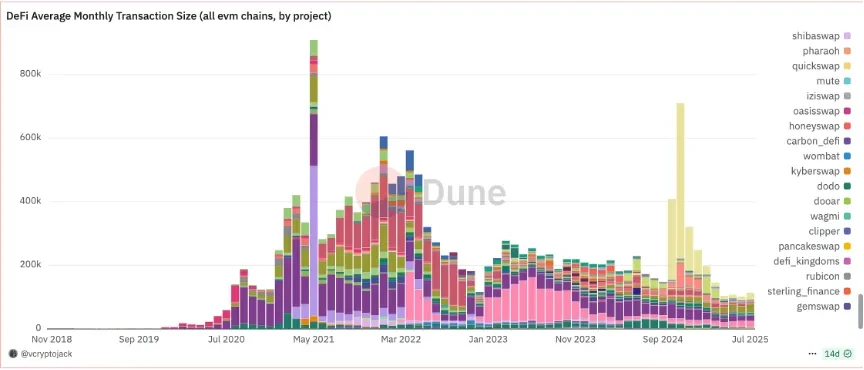
Image Source | dune:https://dune.com/queries/4688388/7800121
This chart shows the trading trends of DeFi applications on various EVM architecture chains. Although some EVMs are not Ethereum and its L2 ecosystems, we can see that from the most disruptive period in 2021, when several heroes competed for hegemony to today, it's unclear how many colors (projects) are blooming on various chains, each meeting diverse on-chain financial needs.
On the other hand, from CryptoPunks to Bored Ape Yacht Club, NFTs not only redefined digital ownership, but also found a new value anchor for Ethereum in the fields of digital art and culture. The rise of OpenSea/Blur proved Ethereum's huge potential as cultural infrastructure, and the foundation of all this was Ethereum's complete token standard system.
It's worth mentioning that even now, the CryptoPunks single project (as shown in the gray part on the left of the figure below) still occupies a significant share of the entire NFT market. It itself appeared even before the NFT standard, and the contract itself has built-in trading market functions. With an on-chain architecture, it can even directly interact on-chain to complete listing and trading without a frontend.
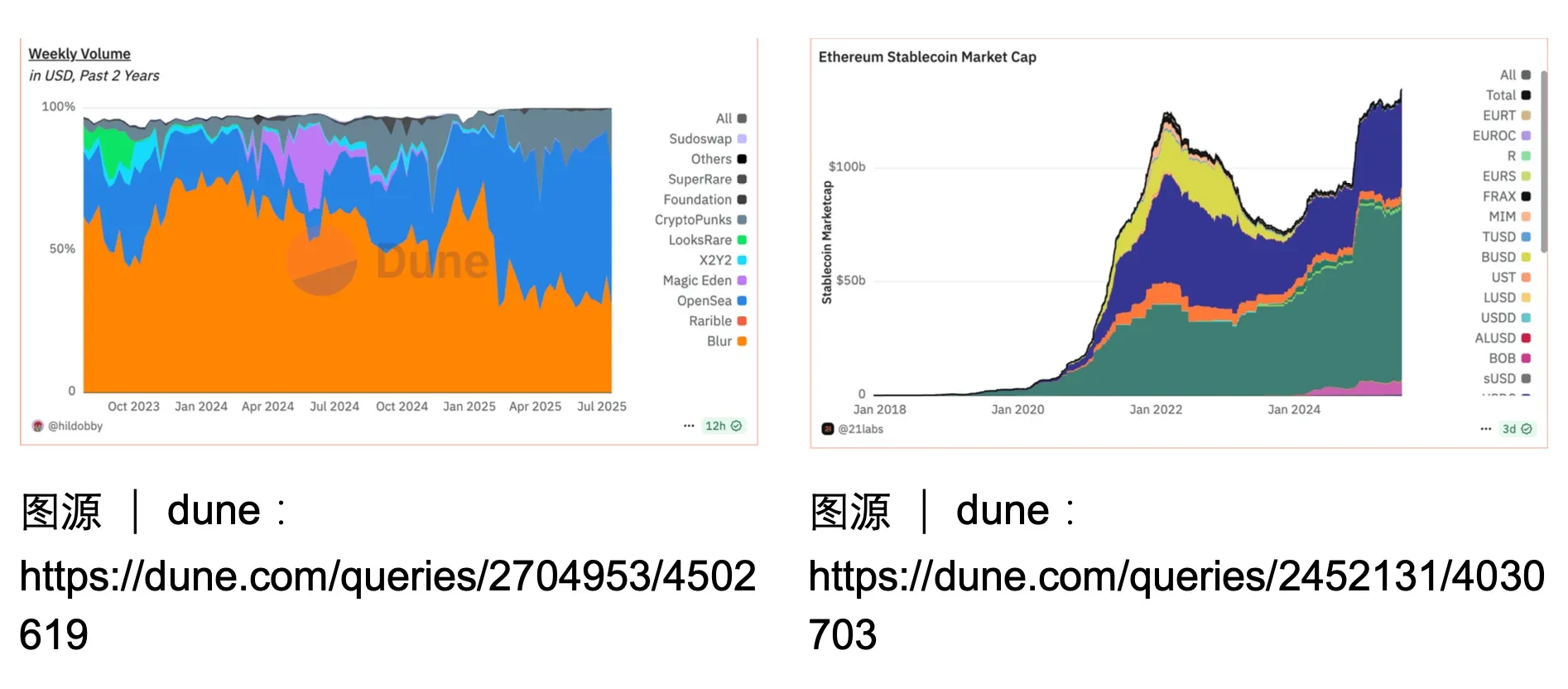
In terms of stablecoins, after the 2021 DeFi Summer, over $130B in funds is divided among USDC, USDT, DAI, and others.
Looking back over these ten years, from the initial ERC-20 to ERC-721, ERC-1155, to the emerging standards ERC-3525, ERC-3475 currently being explored, Ethereum has built a digitalization framework capable of expressing almost all asset types in the real world.
Token Standard
Type
Main Features
Use Cases
ERC-20
Fungible Token
Divisible, replaceable
Currency, points, governance tokens
ERC-721
Non-Fungible Token
Unique, indivisible
Artwork, collectibles, identity proof
ERC-1155
Multi-Standard Token
Fungible + non-fungible hybrid
Game items, batch NFT management
ERC-3525
Semi-Fungible Token
Slot grouping management, supports value transfer
Bonds, financial assets, fractional investment
ERC-3475
Contractual Debt Token
Highly customizable, on-chain contract storage
Debt contracts, commercial agreements, complex protocols
These five standards constitute a complete expression system from simple currency to complex financial contracts. There are more standards not yet finalized but already gradually enabled in different applications, and there will continue to be room.
This is also the source of innovation. Only a market built on a more open protocol layer has more room for smart people to play. Through EIP (Ethereum Improvement Proposal), it itself does not create products, but a set of Ethereum improvement proposal mechanisms that allow protocol participants to reach consensus at different levels. Whether it's contract standards, client implementations, or user experience-related process optimizations, every improvement suggestion can be recorded by history, technically reviewed, and ultimately accepted or rejected by the network.
2023-2025: Rollup-Centric Era Divergence
Ethereum's Expansion Road: Layer 2
This road has come a long way. Currently, Layer 2 has become an important part of the Ethereum ecosystem, with transaction counts accounting for 85% of the total, transaction volume accounting for 31%, and active addresses reaching 3-4 times that of the Ethereum mainnet. Behind this successful expansion lies a more complex process of comprehensive reconstruction of technology and business models.
Previously mentioned, Ethereum's TPS was 15/s. So what is the current actual TPS of the entire Ethereum ecosystem?
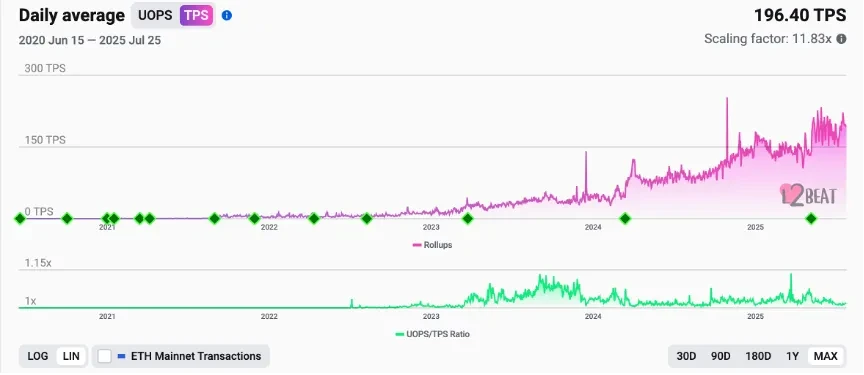
Image Source | L2beat:https://l2beat.com/scaling/activity
Vitalik once used blobs to calculate it comprehensively: using EIP-4844, we now have 3 blobs per slot, each slot's data bandwidth is 384 kB, which is 32 kB per second. Each transaction requires about 150 bytes on-chain, so we get ~210 tx/sec.
Comparing with the actual numbers on L2beat, it's about the same. Achieving over tenfold improvement in just a few years is indeed powerful.
How do we understand EIP-4844's Blob? There's an interesting website where you can feel the difference.
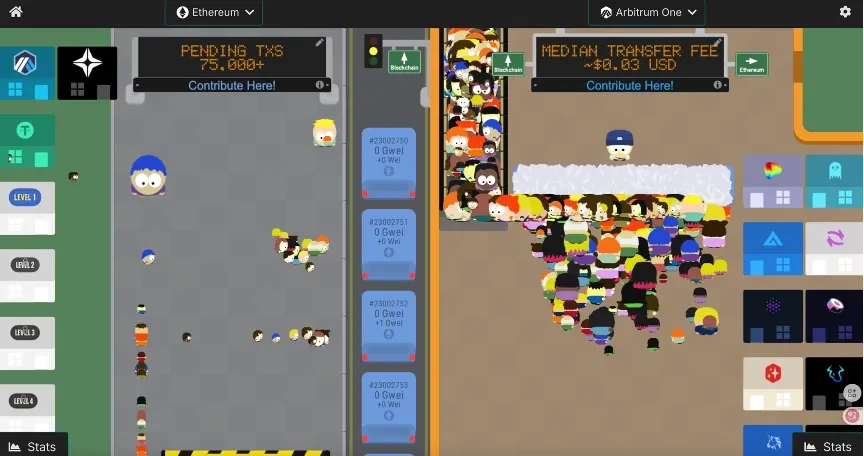
Image Source | Tx City:https://txcity.io/v/eth-arbi
First, let's look at the left side. This is Ethereum's block production process. Each person in the picture is a transaction interacting with some application, then entering different blocks according to gas price, completing packing and departure.
Then, looking at the right side, it's one of Ethereum's Layer2s, Arbitrum One. Similarly, each person's transaction interacting with an application will leave a note at the counter. After a certain time, a postman will come to collect all transactions overall, forming the current blob, and then this postman walks to the left side's Ethereum mainnet to submit and enter a carriage.
In this way, Blob avoids non-essential data being written to the Ethereum mainnet for a long time, only playing a role in verification and for a period of time, so it reduces fees on Layer2 by 90%.
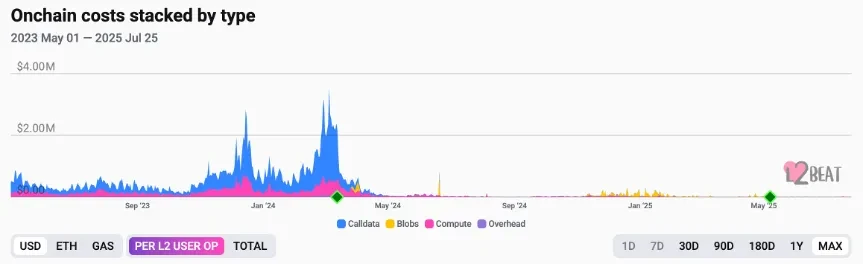
Image Source | L2beat:https://l2beat.com/scaling/costs
However, objectively speaking, market views on this are mixed. Because L2 has not brought a proportional increase in revenue to Ethereum. EIP-1559 previously brought a deflationary mechanism through burning ETH, which brought cheers from the community, because deflation often represents value appreciation for established groups.
But today, with 85% of transactions moving to L2, MEV revenue is naturally intercepted by various layer rollups, and the mainnet has returned to an inflationary state. Inflation itself actually affects Ethereum staking security (currencies that depreciate long-term naturally tend to be held long-term).
But in my view, Ethereum actively giving up profits to exchange for ecosystem prosperity did not adopt the traditional "enterprise" approach—maintaining